The Survey of Employment, Payrolls and Hours (SEPH) is a survey of employers and provides very detailed monthly information of the Canadian labour force. Another source of labour force information, the monthly Labour Force Survey is a survey of households, providing information producing the headlines unemployment rate based on the estimated number of people actively participating in the search for work.
SEPH provides very detailed information. Payroll employment, as measured by the SEPH, refers to the number of employees receiving pay and benefits (employment income) during a given month. The survey excludes the self-employed, owners and partners of unincorporated businesses and professional practices, and employees in the agricultural sector.
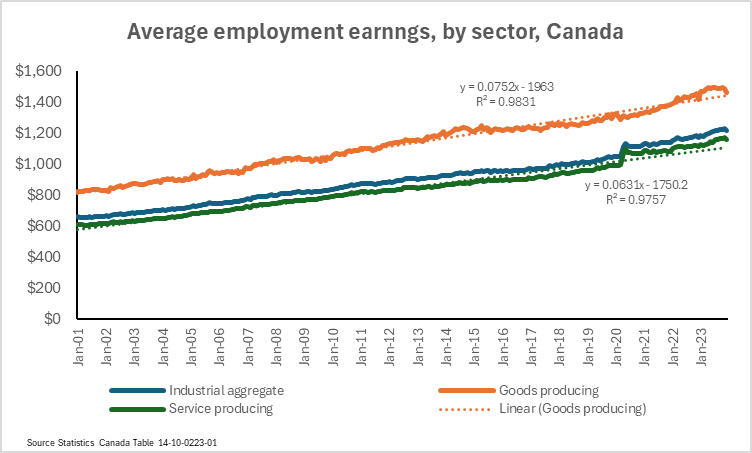
This post will focus on average employment weekly earnings, as reported by employers since January 2001.
The Figure below summaries the principle findings of the data. Over the last quarter century average employment earnings have risen consistently, goods-producing industries pay in the order of a quarter above the service producing industries although the service sector employees received and retained a bump-up in their weekly earnings since the advent of the covid-19 pandemic. Simple linear regressions are very significant for both sectors with R-squared values in the very high 90s. It is interesting that service-producing sector earnings have remained above their trend lines since 2020 while goods-producing sector has fluctuated around their trend line.
Regional employment earning trends will be presented over the course of the next set of presentations.
 LG Economic Insights
Leave a comment