High food prices and its effect on food security and global political stability is once again having its impact in domestic North American, European, Asian and African socio-economies. Climate change, war, trade policies and transportation infrastructure are all contributing to high food prices.
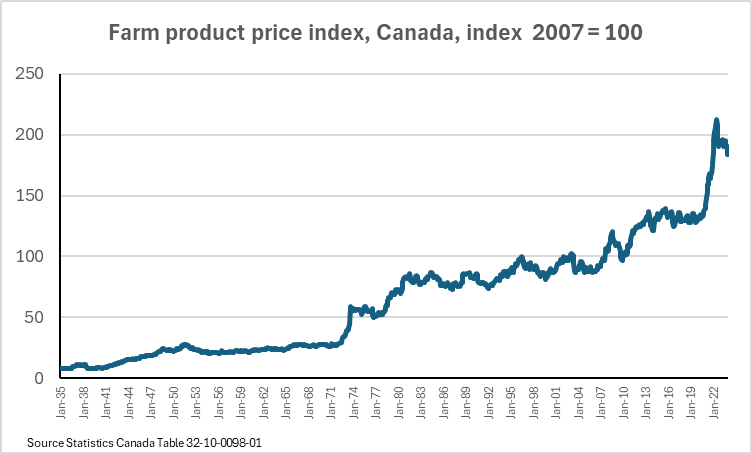
Statistics Canada has tracked the farm prices since at least 1935, publishing the Farm Product Price Index. The basket of farm products included in the index has been updated through the years to include livestock products in 1992.
From the early 1950s until the early 1970s farm product prices were stable at a relatively low level, taking a sharp spike upward in the early 1970s. Reasons for the sharp price increase are complex and will be left to another post. From the mid 1970s to the early 20-teens farm prices increased regularly at a moderate rate. At the beginning of 2020 co-incident with the outbreak of covid-19 and following the disruption of Ukrainian grain and fertilizer shipments, the price index took it largest spike upward over the eight decades of the price index.
The United Nations Food and Agriculture Organization (FAO) also monitors global farm prices and publishes a global price index. The FAO food index starts in 1990 and confirms the direction of the the price movements as documented by Statistics Canada for Canadians.
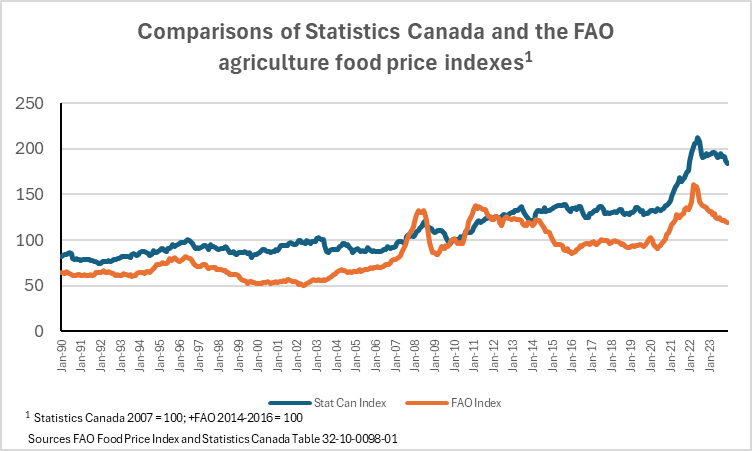
The FAO index also indicates that food prices have spiked upward at the beginning of the current decade but also indicates that global agriculture prices had an earlier surge after the 2008 global financial crisis. Canadian farm prices had strengthened after the 2008 global financial crisis but not to the degree that world prices increased.
 LG Economic Insights
Leave a comment