The economy of India is one of the fastest growing and largest economies in the world. The Canadian economy may not be optimizing its participation in the Indian growth, The International Monetary Fund estimated and projected the performance of key economies as noted in Table 1. India has the fastest growing economy measured by GDP.
| Estimate | Projected | Projected | |
| 2023 | 2024 | 2025 | |
| World Economy | 3.1% | 3.1% | 3.2% |
| India | 6.7% | 6.5% | 6.5% |
| China | 5.2% | 4.6% | 4.1% |
| Canada | 1.1% | 1.4% | 2.3% |
| Advanced Nations | 1.6% | 1.5% | 1.8% |
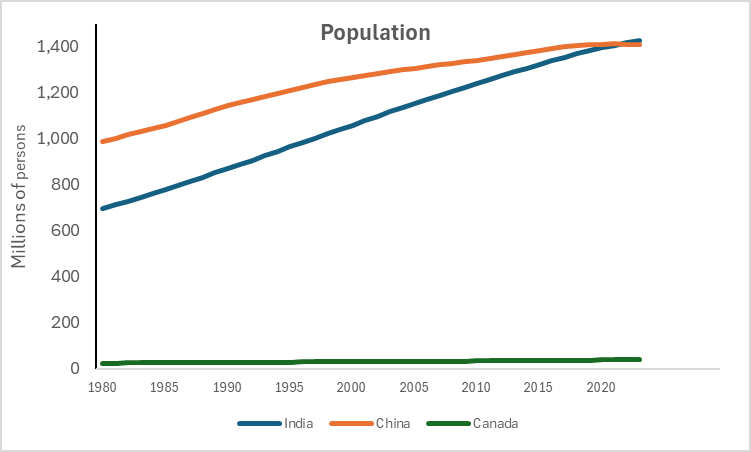
India’s population surpassed China earlier in the decade. The size of the population relates to the potential size of the domestics labour force and consumer market which along with rising productivity (education, health and capital) underly accelerating economic growth rates.
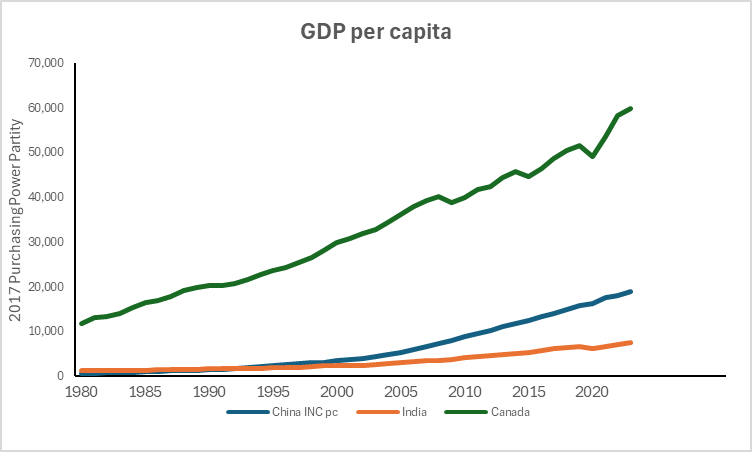
Per capita GDP for India compared to China and Canada is illustrated in Figure 1. Per capita GDP is a direct measure of productivity per capita. Noting that there is much room to improve labour productivity it is reasonable to expect the Indian economy to drive global economic growth provided no undermining steps are taken. Examples of economies failing to progress after adopting bad economic policies will be the subject of a future post.
Canada has had the good fortune of having close international trade ties with the leading global economies the United Kingdom in Canada’s early years and the United States as global economic leadership shifted from the UK to the USA. Today global economic leadership may be undergoing another shift towards Asia whether it be China or India or both.
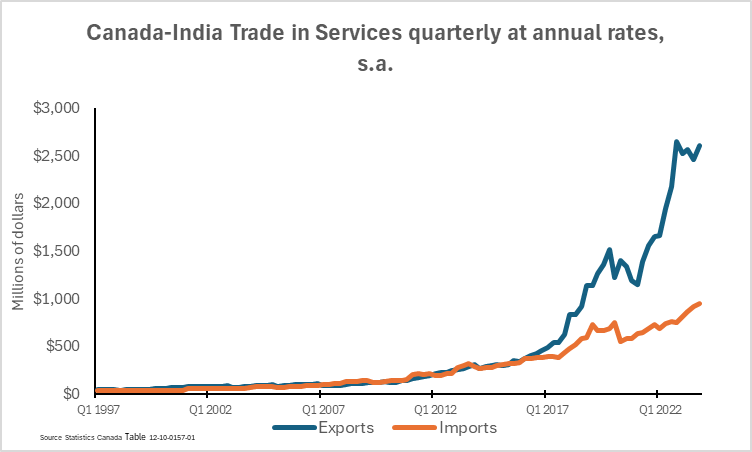
Given the rise of the Indian economy Canada’s ties to India are anemic. Canada-India trade in services and goods are illustrated in Figure 3. Growth of the trade in services does not reflect the scale of growth of the Indian GDP. However Canada has a small surplus in the trade in services.
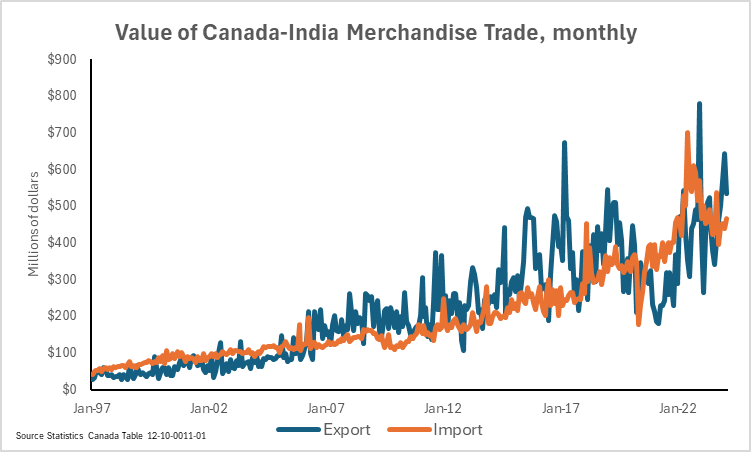
As illustrated in Figure 4 the merchandise trade is balanced between the two economies.
 LG Economic Insights
Leave a comment