Since the beginning the United States has harassed Canadian sawmillers with trade penalties on Canadian lumber imports into the American market. On March 5, 2024, the U.S. Department of Commerce published the Notice of Initiation of its sixth administrative review of the softwood lumber countervailing and anti-dumping duty orders. The Forever War continues.
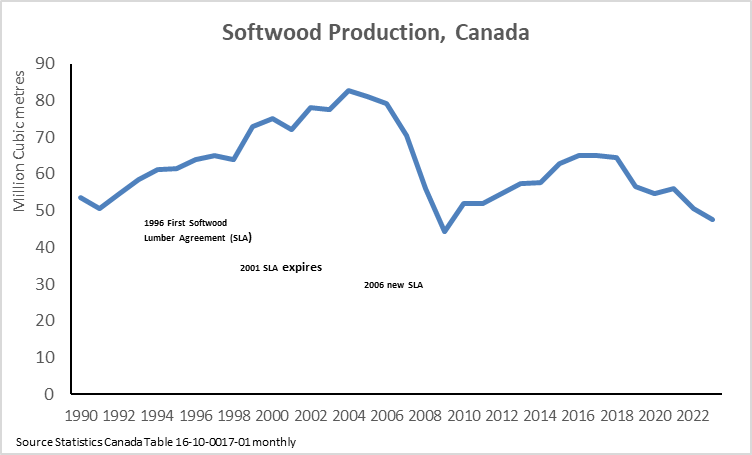
Figure 1 shows Canadian softwood lumber productions since 1990 with key years in the softwood lumber dispute identified. This post is not intended to be a comprehensive analysis of the future potential of the Canadian lumber industry it simply implies that American trade harassment has limited its growth.
The post World War 2 period has been particularly litigious. Quoting liberally from the Congressional Research Service (February 2, 2001) :
The U.S. Lumbermen’s Economic Survival Committee prompted congressional hearings and a White House task force and petitioned the U.S. Tariff Commission (now the U.S. International Trade Commission) for restrictions on Canadian lumber imports. In 1963, the Tariff Commission chose not to impose restrictions, and efforts to restrict lumber imports abated.
The Coalition for Fair Canadian Lumber Imports, came together, and in October 1982, filed a countervailing duty petition with the International Trade Administration (ITA) of the U.S. Department of Commerce, … in March 1983 that Canadian subsidies were de minimis (less than 0.5%), and that stumpage fees were not subsidies because they were generally available to all industries (even though only one group of industries was interested), were established using the same process for all stumpage purchasers (i.e., were not preferential), and did not relieve the purchasers of any statutory or contractual obligations or production costs. The final ITA finding was consistent with the preliminary, and thus, no countervailing duty was established.
...The CFLI [Coalition for Fair Lumber Imports] apparently decided that political action would be needed to reverse the 1983 ITA ruling. Numerous bills were introduced in 1985 to restrict Canadian lumber imports directly, or indirectly by revising statutory definitions of naturaI subsidies. At the same time, the Reagan Administration was seeking approval of “fast-track” authority for the U.S.-Canada Free Trade Agreement then being negotiated. In February 1986, Sen. Max Baucus led a floor discussion about concerns over Canadian lumber imports, and promised opposition to the free trade agreement if the lumber trade dispute was not resolved first.
In July, the ITC again reached a preliminary decision that there was “a reasonable indication” that the U.S. industry had been “materially injured” by imports of Canadian lumber. On October 22, the ITA reversed its 1983 decision, with a preliminary finding that Canadian stumpage was actually provided to a single industry at preferential rates, and that the “estimated net subsidy is 15.00 percent ad valorem” (i.e., 15% of lumber market prices). This finding established a preliminary 15% ad valorem countervailing duty on Canadian softwood lumber imports, pending the final ITA subsidy determination due on December 31, 1986.
And an update from ChatGPT:
In 2006, a new Softwood Lumber Agreement was reached between Canada and the United States. Under this agreement, Canada agreed to impose export taxes and quotas on its softwood lumber exports to the US, and in return, the US agreed to refund some of the tariffs it had collected.
In 2017 the 2006 Agreement expired, and negotiations for a new agreement failed. The United States imposed new tariffs on Canadian softwood lumber, alleging that Canada was unfairly subsidizing its lumber industry.
 LG Economic Insights
Leave a comment