
Headlines are linking interest rates, inflation and labour market as factors directly impacting short-term economic forecasts. Very simply, interest rates are used to cool (stimulate) an overheated (slumping) economy exhibiting rising (falling) wages that push up (down) prices. Wages, the price of labour and an outcome of the market balancing of the supply and the demand for workers is the dynamic driver of the market connection.
This post focuses on the trend for average weekly wages (labour compensation).
Labour compensation has averaged 57 per cent of Canada’s gross domestic product (GDP) from 1997 to 2020, the latest year available, quarterly data indicates that labour compensation remained at this level through to 2023. This period includes a number of economic shocks, the most serious in its impact on employment was the covid-19 pandemic.
Labour compensation per hour increased at a linear rate during the period, with no indications of a break in the long-term trend until the covid-19 pandemic, January 2020. See Figure 1.

After January 2020 average weekly wages in the service industries shifted higher while average weekly wages in the goods industries continued along their pre-pandemic trend. This suggests that a more detailed presentation focusing on wages for public-facing services may provide some insights for the labour market.
As shown in Figure 2, the supply of labour remained suppressed until the end of 2021, then recovered to the pre-pandemic level.
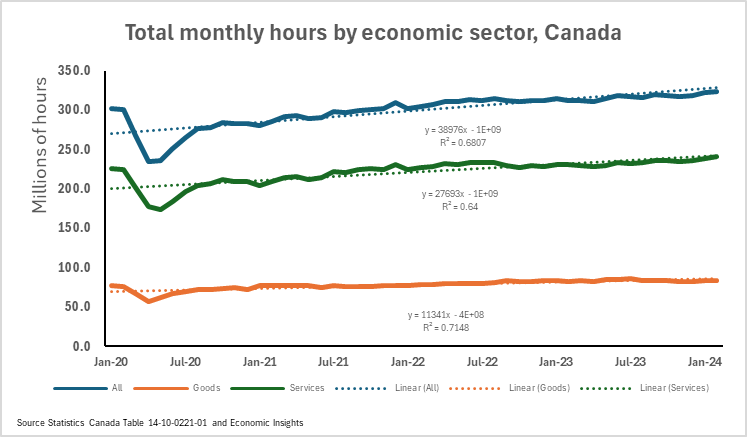
A general observation is that labour compensation has remained fairly stable throughout the last quarter of a century even in the face of as series of severe economic shocks. However the wage effects of the most recent shock – the pandemic – may unwind over next couple of years.
Statistics Canada defines total labour compensation as : The total compensation for all jobs consists of all payments in cash or in kind made by domestic producers to workers for services rendered. It includes wages and salaries and employer’s social contributions of employees, plus an imputed labour income for self-employed workers.
 LG Economic Insights
Leave a comment