
The effect of inflation on the cost of living and real, inflation adjusted income, is a headline issue in the upcoming elections. For purposes of this post income is measured as weekly earnings, including overtime, by Statistics Canada reported as Table 14-10-2004-01. The table provides a detailed breakdown by industry but, again for the purpose of this post, only the three industrial groupings are discussed: the industrial aggregate, goods producing industries and service producing industries. Inflation is measured by the consumer price index. Data is available for the ten Canadian provinces and three northern territories. The source is Statistics Canada Table 18-10-0005-01.
The anchor year is 2018, the full year prior to the onset of the covid-19 recession.
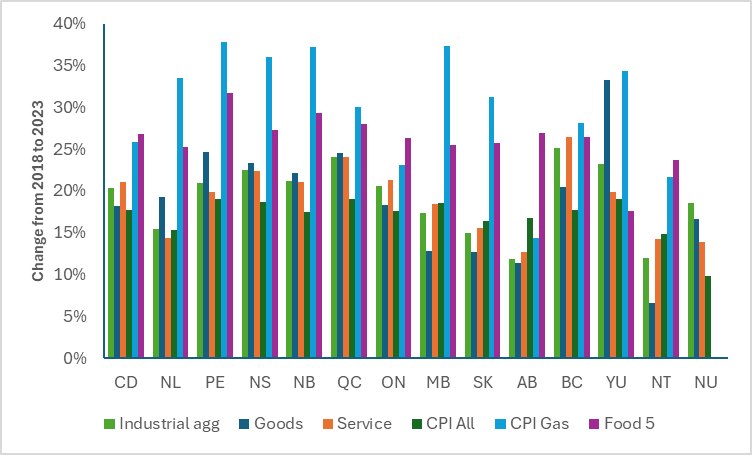
From 2018 to 2023 average weekly earnings increased by 20.4 per cent, from $1,001.19 to $1,205.01. For the same time period average weekly earnings for employees in goods-producing industries increased by 18.3 per cent from $1,253.17 to $1,481.93. The corresponding earnings of employees of service-producing industries went from $945.81 to $1,145.63.
Over the same period the consumer price index rose by 17.8 per cent, less than earnings meaning that the inflation-adjusted weekly earnings rose faster than the cost of living for all employee groupings. In response to changing prices consumers have the opportunity to shift product consumptions patterns to sometimes cheaper substitutes.
Street level reporting notes complaints of the increasing cost of living with the discussion focusing on two products, gasoline and groceries. Consumers have direct and frequent awareness of gasoline prices and grocery bills. The CPI-based price of gasoline increased by 25.8 per cent well above increased employee earnings and the price of groceries rose by 26.8 per cent.
Observation 1. Real weekly income increased for all three employee groups faster than the consumer price index since the start of the covid-19 recession.
Observation 2. Unlike economists who wait a month for Statistics Canada to report last month’s consumer price rise, many consumers base their perception on their lived life experiences at the gas station and the grocery store. Consequently even though over all consumer prices rose less than weekly earnings, the out sized exposure to gas and grocery prices led consumers to perceive the cost of living is growing faster than their income.
In response to the question implied by the title of this post the answer is yes, the stat depends on what is being measured, when and by whom. The stat is both alive and un-alive.
Bonus graph.
The Statistics Canada data base covers all 13 Canadian senior governance jurisdictions, many more industries going back to at least 2001. Figure 1 is a working figure compiled in preparation of this post. It is much too busy but the source tables are specified above.
 LG Economic Insights
Leave a comment