
A major theme of posts on LG Economic Insights website has been the previously unimagined progress of the global socio-economy over the last century and a half. But can this level of wealth (measured by GDP per capita) and health (measured by expected life expectancy) be sustained for future generations? Even the Roman Empire and the Tang dynasty ended. And has this era of wealth and health set a floor for future economies or does the floor remain a subsistence economy?
As of this writing the Geneva Academy of International Humanitarian Law and Human Rights is monitoring over 110 armed conflicts across the world. For purposes of this post three countries experiencing socio-economic disruption were selected for examination. Also for purposes of this post the term socio-economic disruption includes outright war with another country, and armed civil war and civil upheaval. It is accepted without further evidence that countries in socio-economic disruption do not place a high priority on collecting accurate data and that such information may be weaponized to support government actions.
The three countries selected for this post include the Russian Federation, a country at war with Ukraine, Syrian Arab Republic in the shadow of a civil war and Venezuela in the midst of a civil upheaval. And data was available for each of the countries. France was included as a reference country.
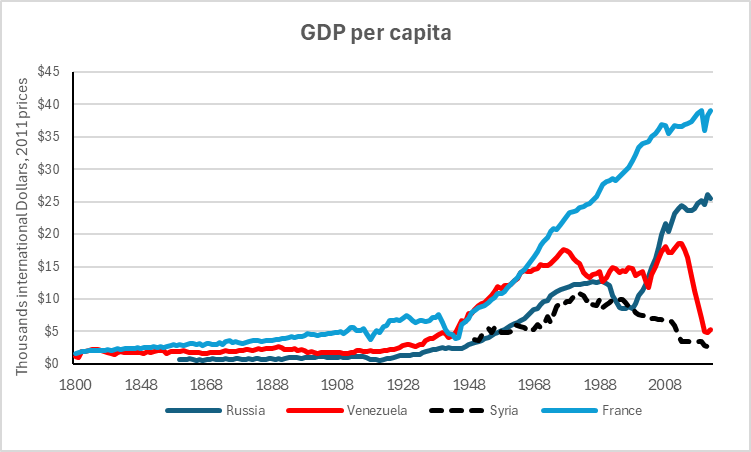
All three countries experienced significant declines in GDP per capita. Russia had a severe decline in the initial period of transition from a communist economy to its hybrid state-led economy of today. Shortly after the turn of the century Russia recovered to, then exceeded, GDP per capita levels of the mid-1980’s. The fiscal stimulus of the Russia-Ukraine war will contribute to the higher per capita GDP. Syria experienced a severe decline in the wake of the Arab Spring and the subsequent the civil war. GDP per capita peaked in the mid-90’s and continues to fall. No sign of economic resilience. Venezuela had transformed to a petrostate and has seen a two thirds decline in GDP per capita since the early 2010’s. The decline was caused by political rather than economic factors.
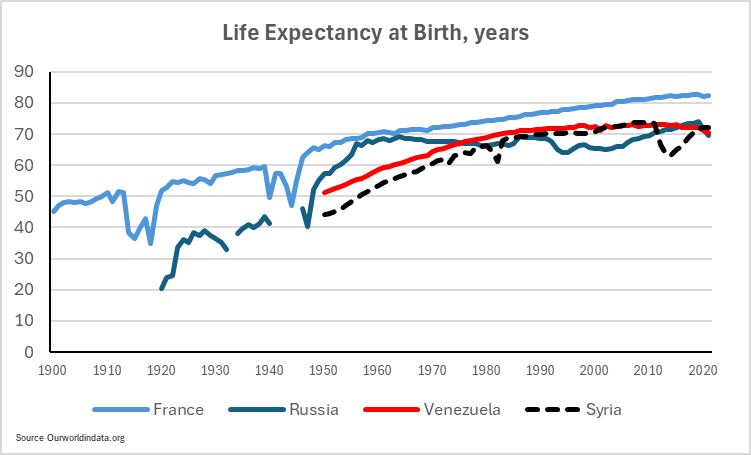
Syria and Venezuela have experienced the largest decline of life expectancy after the socio-economic disruption but Syria is reporting a return to pre-disruption levels. Venezuela and Russia have leveled off but each recorded significant declines in 202. Russia declined from almost 74 years in 2019 to under 70 years in 2021. Venezuela declined from from just over 72 years to 70.5 over the same period.
Observations
Socio-economic disruptions have direct impacts on the resilience and trajectory of the counties affected. Specifically on the wealth and health infrastructure and legacy of the country.
Socio-economic disruptions have many causes, the three identified in this post were (1) external armed conflict, (2) armed civil war and (3) internal civil upheaval.
Resilience is not to be assumed but then again there are no examples, yet, of a country falling to a subsistence economy.
 LG Economic Insights
Leave a comment