At its most granular level, the economy is composed of three fundamental factors: labour, capital and land. These factors interact to shape economic activity, production and distribution of goods and services. Much attention is focused on the role and productivity of labour and capital. In spite of its dominant role in the economic history of Canada, the economic value and productivity of natural resources, aka land, is largely ignored. Harold Innis believed that the production and distribution of natural resource products shaped the growth of the Canadian economy. First the cod fishery off the east coast, then the fur trade throughout central and northern Canada followed by wheat exports. Mining and oil & gas followed with the construction of the needed transportation infrastructure. Many of the staples are owned by the Crown and their pricing is in a mess and undermines any effort to attribute a “productivity” measure to them. A simple example is the forever timber trade war with the Americans. The Americans argue that the Crown “sells” standing timber to companies at below market rates and, from the American perspective, it is a subsidy from the Crown to private companies. But this is a topic for a separate post.
Entrepreneurship and technology have had critical roles connecting the three physical factors of production to the engine that drove the leap from the static subsistence socio-economies for most of human exitance to today’s level of wealth and q uality of life. Improved productivity of labour and capital are commonly measured by economic and statistical agencies. More difficult has been the measurement of the economic productivity of technology and entrepreneurship.
An estimate of the combined productivity of entrepreneurship, including innovative business models, and technology is multifactor productivity (MFP). The Organization for Economic Co-operation and Development offers the following functional definition of MFP:
“Multifactor productivity (MFP) reflects the overall efficiency with which labour and capital inputs are used together in the production process. Changes in MFP reflect the effects of changes in management practices, brand names, organizational change, general knowledge, network effects, spillovers from production factors, adjustment costs, economies of scale, the effects of imperfect competition and measurement errors. Growth in MFP is measured as a residual, i.e. that part of GDP growth that cannot be explained by changes in labour and capital inputs. In simple terms therefore, if labour and capital inputs remained unchanged between two periods, any changes in output would reflect changes in MFP. This indicator is measured as an index and in annual growth rates.“
Four countries were selected to illustrate the post War trend of MFP. Canada is the resident country for LG Economics Insights. It is an open, advanced economy emerging out of the war as a major economy but has declined in relative wealth over the last generation. It is now an ordinary advanced economy. The United States was and remains the largest economy in the world. Germany is the largest national economy within the European Union. China is the fast rising next super economy.
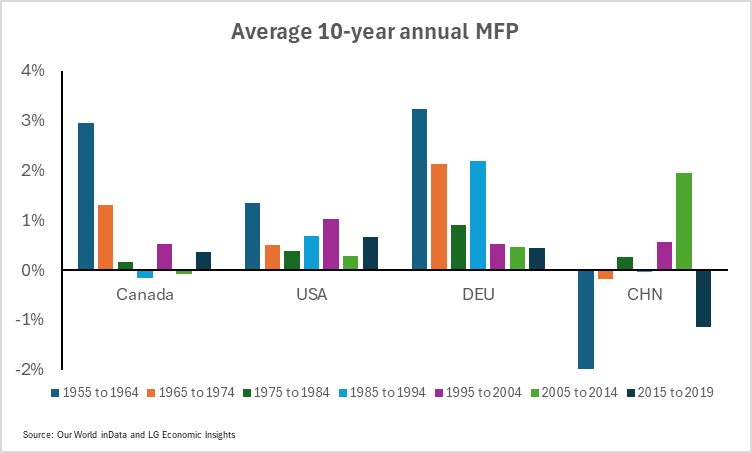
The following comments pertain to Figure 1:
- Canadian MFP was strong at the beginning of the period until the early 1970’s. Afterwards it has been anemic, staggering – approaching 2 percent on occasion and often below zero. Of these selected countries Canada had the poorest MFP over the entire period.
- USA MFP has been consistently between zero and two percent since the early 1980s. The best performance of the selected countries over that period.
- Germany was consistently above zero until the 2008 global financial crisis.
- China started sluggishly the had a strong 20 year run from 1995 to 2014. Then a steep decline.
Lessons can be learned by comparing the different outcomes from different initial circumstances for each of these economies. Without the benefits of MFP the global socio-economy’s continued progress is not assured.
 LG Economic Insights
Leave a comment