On September 17, 2023 Statistics Canada announced that the Consumer Price Index rose 2.0% year over year. This was reported as a policy victory as inflation had been brought down to its long standing target of 2 per cent! As noted in a previous post, prices changing to reflect a dynamic economy constantly adjusting to ever changing supply and demand conditions is an indicator of a healthy market-based capitalist economy. As illustrated in Figure 1 below, changing prices are a normal feature of the Canadian economy. In the short-run it does impact the cost-of-living differentially for segments of Canadian society and from a real politics perspective it must be dealt with.

No one expects price levels to return to 1949 levels so society deals with the higher prices in the context of a healthy economy delivering higher incomes.
It is the rate of change of prices that concerns most people. Adjusting to the rate of change involves shifting consumer preferences to lower cost products, often brought about by economic competition by suppliers, expanded geographic market reach and new business models. And by innovation and new products. And, of course, higher earnings. Inflation is a measure of the rate of price changes. This is illustrated in Figure 2.
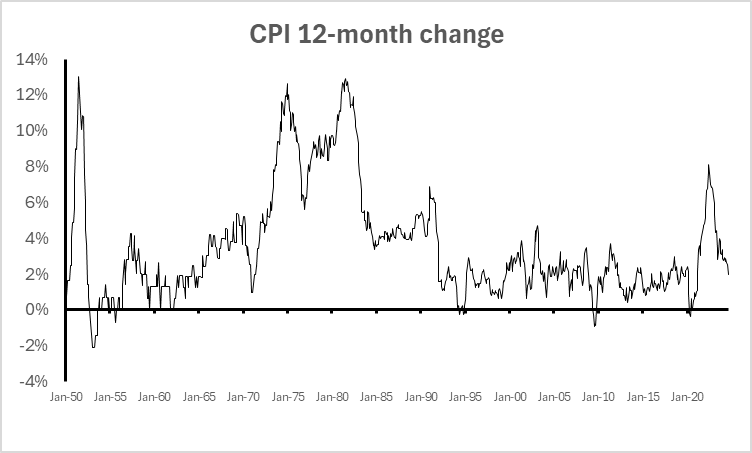
Figure 2. Inflation as measured by changes in the CPI.
The inflation of the 1970s through mid 1980s had a profound impact on the established macroeconomic model of the economics profession – high inflation and levels of unemployment (not shown here) were not supposed to co-exist. The matter is still not settled but in spite of a number of economic shocks since the turn of the century inflation was contained until implementation emergency economic-based measures attributed to covid-19 pandemic. The medical emergency is now effectively over (or not, only time will tell) and the medicine has had its effect. We wait for the next medical emergency.
It is unmistakable that the economy has proven to be resilient in the face of economic, political and medical shocks.
It is noted that many expect a future shock to be environment-driven, global warming and greenhouse gases fueling the expected crisis. In this context Figure 3 compares the relative consumer-facing prices of three energy fuels: electricity, gasoline and natural gas measured against the CPI.
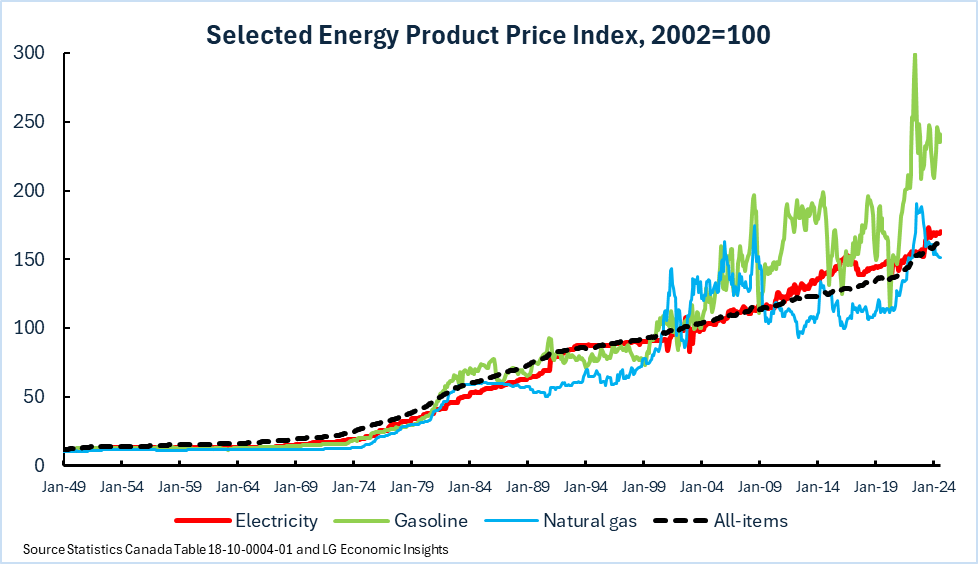
Until the turn of the century the three fuels did not increase in price relative to the general price level, notwithstanding the weakness of natural gas prices after the early 1980s. Energy prices diverged after 2010. Gasoline prices increased dramatically, electricity stayed even with the CPI and natural gas prices continued to be weak. This augers well for the conversion of domestic cars from carbon-based fuels to electricity (EVs). The price incentive to consumers is compatible with environmental policy, but the supporting infrastructure lags.
To respond the question posed by the title of this post, the answer is NO, inflation is NOT over. Thank goodness!
Post Script: Recent global medical shocks and initial detection year in parenthesis
- HIV (1980s)
- SARS (2002)
- Swine flu (2009)
- MERS (2012)
- Ebola (2014)
- Zika (2015)
- Covid-19 (2019)
- Mpox (2022)
Source: https://www.cfr.org/timeline/major-epidemics-modern-era
The takeaway is that international medical emergencies are normal feature of the modern world.
 LG Economic Insights
Leave a comment