
This is a self-indulgent post. Having spent the better part of the last decade and a half in a small, northern and remote community, this author has developed a full appreciation of the contribution of such communities to the texture of Canada.
Summer has ended, autumn has arrived and the new NHL hockey season begins within a month. This post focuses on two of the key Canadian feeder leagues, developing hockey players for the next professional hockey tier: the Ontario Hockey League (OHL) and the Quebec Maritime Junior Hockey League (QMJHL). Together with the Western Hockey League these three leagues are members of the Canadian Hockey Leagues (CHL) which sponsors the annual Memorial Cup Tournament, the premier event of junior hockey in Canada.
All junior leagues include small, northern (which many southerners would call “remote”) communities as well as large urban cities. This post presents the basic employment statistics for the small and northern communities in the two eastern junior leagues. Employment statistics will be a proxy for the underlying socioeconomic health of the community. Although individual community data is an input into the analysis, data is pooled for the small and northern communities for each league. Even with fierce team loyalty within a community, teams may move in tough economic and finance circumstances.
One foundational assumption of this post is that the fan base is critical for the economic sustainability of teams in small and northern communities. The employment status is one measure of community economic vitality and sustainability. The employment status is measured by the employment rate (share of labour force with employment), the unemployment rate (share of the labour force actively searching for a job) and the size of the labour force. Note: one statistic was not available for the community level at this time, i.e. the labour force participation rate – the share of residents aged 15 years and over, active in the labour force.
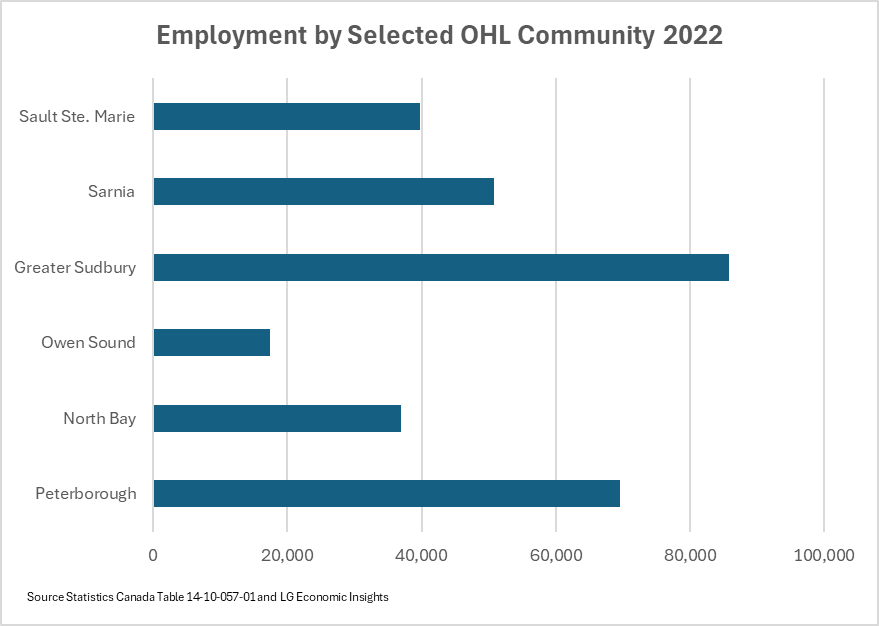
The OHL has 20 teams, 3 American based teams, and 11 southern and larger urban based teams. For purposes of this post only 6 of the 20 teams were classed as small and northern: the Sault Ste. Marie Greyhounds, the Sarnia Sting, the Sudbury Wolves, the Owen Sound Attack, the North Bay Battalion and the Peterborough Petes. The cut-off for small was Sudbury (indisputably “northern”).
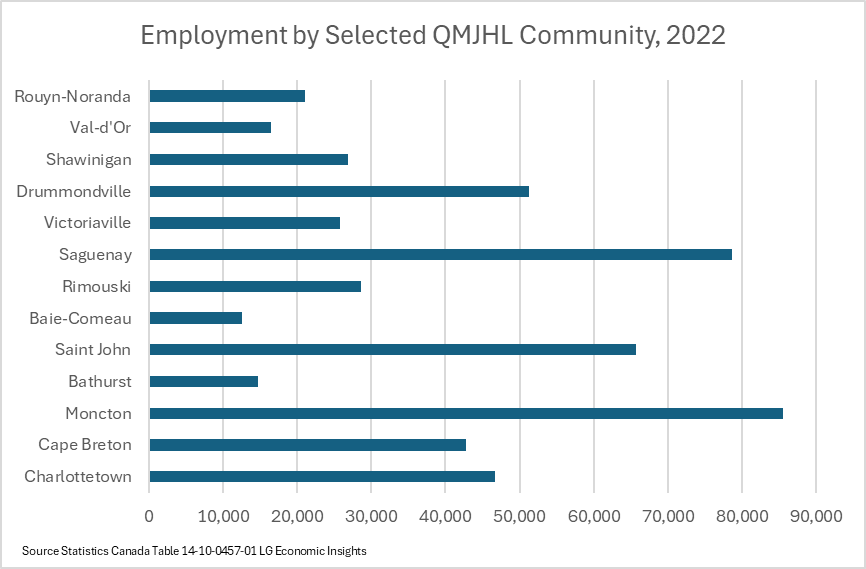
The QMJHL has 18 teams located in Quebec and the three maritime provinces. All are Canadian. Thirteen of the QMJHL teams were included as small and remote: Huskies de Rouyn-Noranda, Foreurs de Val D’Or, Cataractes de Shawinigan, Les Voltigeurs de Drummondville, Tigres de Victoriaville, Chicoutimi Sagueneens, Rimouski Oceanic, Le Drakkar de Baie-Comeau, Saint John Sea Dogs, Acadie-Bathurst Titan, Moncton Wildcats, Cape Breton Eagles and Charlottetown Islanders.
Community-level labour force statistics are pooled by league and presented in Table 1 below for 2022 and 2023. Communities in each pool may change because of financially driven team migration out of or into the small community pool. The purpose of table 1 is to establish a baseline for future monitoring of the economic health of the small and remote communities.
| QMJHL, small & remote communities | |||
| 2022 | 2023 | Change | |
| Labour Force | 1,069,993 | 1,091,176 | 2.0% |
| Employed | 629,857 | 635,118 | 0.8% |
| Unemployed | 48,805 | 49,199 | 0.8% |
| Not in Labour Force | 391,331 | 406,859 | 4.0% |
| Employment Rate | 58.9% | 58.2% | -0.7% |
| Unemployment Rate | 4.6% | 4.5% | -0.1% |
| OHL, small & remote communities | |||
| 2022 | 2023 | Change | |
| Labour Force | 504,196 | 509,929 | 1.1% |
| Employed | 300,444 | 302,009 | 0.5% |
| Unemployed | 25,300 | 27,393 | 8.3% |
| Not in Labour Force | 178,451 | 180,526 | 1.2% |
| Employment Rate | 59.7% | 59.2% | -0.5% |
| Unemployment Rate | 5.1% | 5.4% | 0.3% |
Observations:
- Small and remote communities have significantly higher profile in the QMJHL compared to the OHL.
- Given the challenging health and economic challenges of the early 2020’s the labour force, the number of people employed and the employment rate has increased in 2023 for both community pools.
Additional Information:
 LG Economic Insights
Leave a comment