On August 19 2024 the US Department of Commerce released its final decision of its fifth administrative review of its countervailing duty and anti-dumping duty orders on Canadian softwood lumber imported into the US. See previous post. The combined duty and tariff was doubled, from 8.05% to 14.54%. The fifth review covered calendar 2022. Requests for involvement in the sixth review closed January 2024. The sixth administrative review will cover calendar 2023. The System is scripted and works on a schedule. We know that the thirteenth administrative review will cover calendar 2030 with new charges to be announced in the fall of 2031 along with marginal changes coverage of which Canadian based sawmillers to include and a halving or doubling of the earlier findings. And so on forever. Once the US government transferred responsibility for these reviews from the Department of Justice (led by lawyers influenced by international law principles and legal precedents and global professional reputation) to the Department of Commerce (responsive to domestic political pressure, which they do very well) the off-ramp disappeared. It is indeed a “forever” trade war.
The duties are passed on to American consumers, driving up the cost of new housing construction. House design and costs will reflect the norms for different regions and socioeconomic markets, subsequently a simple estimate of the tariffs on the cost inflation on new houses is not available. Using a back-of-the-envelope approach: assuming that softwood lumber accounts for between one quarter and one third of the cost of house construction, that the ratio of the land of the house to its land base is 1:2 and the average value of a new house is $300,000. The initial combined taxes just announced will add an estimated 1 to 1.4 percent to the cost of a new house over the 2022 tax levels or between 2.4 and 3.2 per cent if the trade taxes were eliminated.
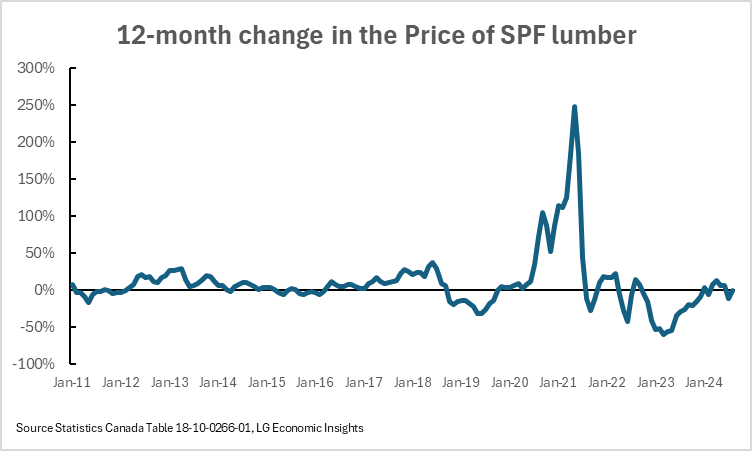
Nevertheless the market price of lumber is and always has been volatile (see Figure 1 below). This means that both sides of the market have and will continue to adjust to rising and falling lumber prices. On the supply side, producers adjust by searching for new markets including products and production levels, On the demand side buyers and builders will substitute other materials where appropriate including adopting new home designs.
Observations
- The softwood lumber trade dispute with the United States has no escape hatch and will continue into the foreseeable future,
- This is an All-American issue within the American political environment. Canadians are not players on the field. The trade taxes do increase the cost of new houses in the United States but not severe enough to generate American domestic allies to offset protectionist American lumber companies.
- See you all in 2031.
- Henceforth this is a domestic Canadian issue, either stay on the merry-go-round or find a novel solution,
 LG Economic Insights
Leave a comment