
Economic progress is measured as GDP per capita, with GDP measured by Purchasing Power Parity to reflect national purchasing power given differences in domestic economies – and constant 2021 international dollars – to mitigate impacts of national currency variance. Increased GDP is driven by increased economic productivity i.e. creating greater value out of the given stock of economic factors of production. There are three classical Factors of Production labour, capital and land. Land includes nature’s endowment of resources and is commonly ignored by modern economists for reasons beyond the scope of this post.
Headline productivity is commonly expressed as value created per unit of labour. Economists express productivity as the increased value created by the mix of factors of production used in the production process. This is called Total Factor Productivity. Innovation for purposes of this post means the increased value created as a result of quality changes in the mix of factors of production. Simply finding more of a factor and using that to increase total production is not deemed to be an innovation. A change in the business model that squeezes greater value out of the factors, or an improvement in the quality of the factor (for example education, health and safety for labour), technological progress for capital (for example internet and communication systems for capital)
This post will report (1) TFP by selected country and (2) TFP for major public jurisdictions in Canada – Canada, the provinces and the territories.
Our World in Data is the source of national TFP data used in this post. The mix of factors used in each country reflects their terms of trade in that country, as such this post focuses on the trend of TFP in each country and not a comparison of the level of TFP by country. Figure 1 illustrates Sweden’s TFP from 1954 to 2019. Sweden is chosen as a an example of the TFP performance of the “typical western economy”. Note the smooth post World War 2 increase until the mid 1970s OPEC oil embargo drove up the price of petroleum. Productivity stagnated from the mid 70s through to the mid 90s. Globalization and the digital revolution drove historically strong productivity increases until the Global Financial Crisis of 2007 to 2009. The crisis was driven in part by the digital revolution itself. The recovery from the GFC has been tepid.
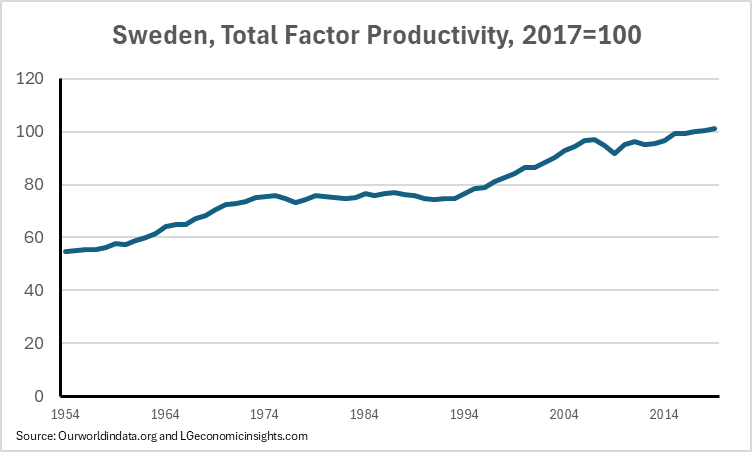
Figure 1. Sweden TPP
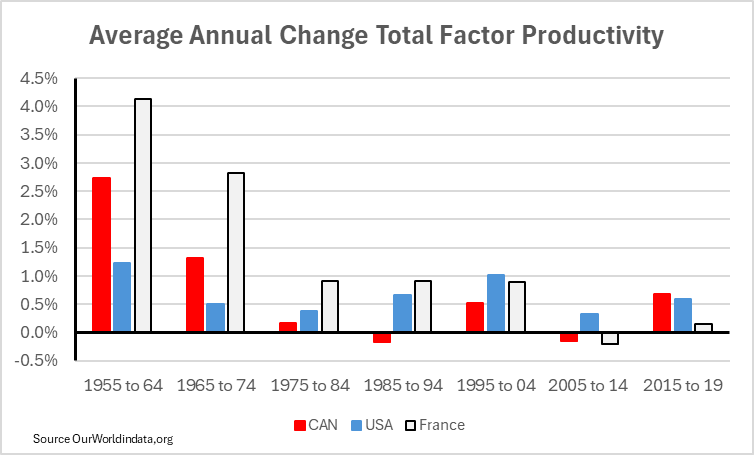
Figure 2.
Figure 2 shows the average annual change of TFP for three countries each a member of the G7 grouping of seven of the world’s advanced national economies. TFP is calculated for seven periods from 1955 to 2019. Productivity increased in all periods for the American economy, an economy characterized as the world’s most as dynamic and innovative. The French economy, often characterized as “European” in the sense of being highly regulated and accommodative to labour, had strong TFP growth until the global financial crisis. Canada, characterized as America’s little brother, has had a very uneven performance since the oil embargo. All three countries had positive TFP growth but only the American economy exhibited constant increasing productivity.
Statistics Canada annually calculates and reports multifactor productivity by major jurisdiction for the business sector and by industry. Multifactor productivity is similar to TFP and the difference is not germane to the thrust of this post.
As illustrated in Figure 3, strong Multifactor Productivity was experienced in three resource rich provinces (land, the third factor of production often ignored in modern macroeconomics) until early into the second decade of the new millennium. Resource sectors included mines, food (agriculture and fisheries), forest products and oil & natural gas.
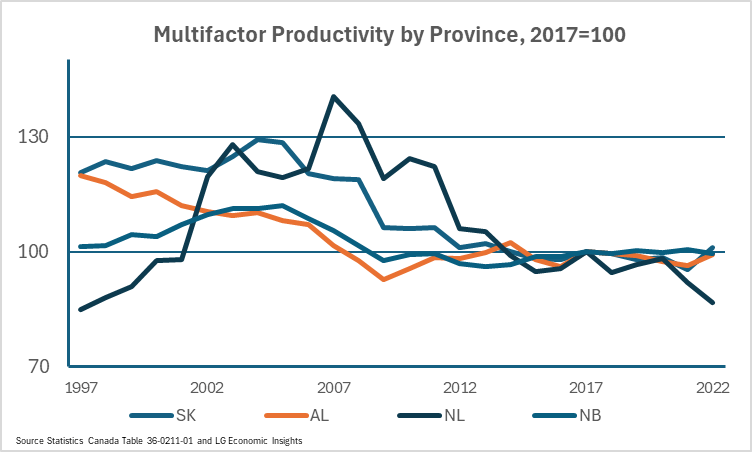
Figure 3. Multifactor Productivity, resource rich provinces
Figure 4 illustrates multifactor productivity for the other non-resource rich provinces. Their productivity is essentially stagnate through the period, or at best, very modest growth.
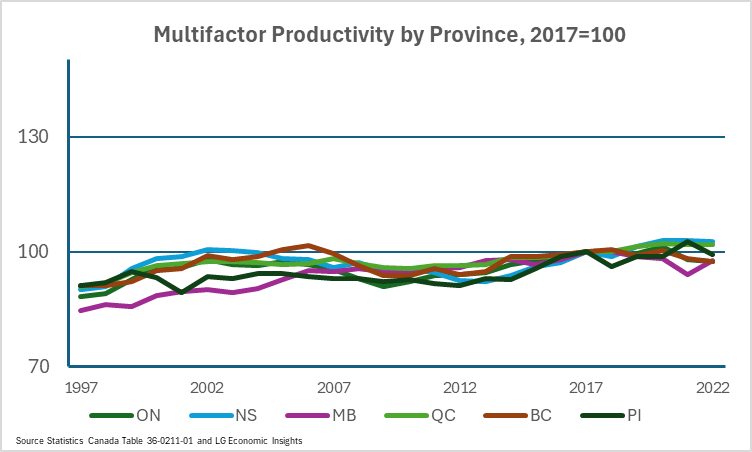
Figure 4. Multifactor productivity by provinces less dependent on resources.
Comments
- Of the advanced countries, the United States has the largest and most diversified economy. TFP maintains a consistent growth trajectory perhaps contributing to a more stable investment and research risk environment.
- Seven of the largest technology companies have their headquarters in the United States, providing the corporate infrastructure to drive continued total factor productivity growth. It is noted that the public infrastructure is an integral element of this process. This includes government contracts, subsidies and regulations on the supply side of the market and as direct consumers on the demand side of the market.
- In Canada resource-rich provinces had higher levels of multifactor productivity during the first decade of the new millennium falling back to normal levels after the resource prices settled back after the covid-19 economy returned to pre-covid levels. Commodity prices are driven by global supply and demand factors many of which are political not strictly economic.
- Without evidence it is suggested that Canadian public sector support for private-sector involvement for technological advances is compromised by the fact that is it dispersed amongst 14 governments each concerned with its residents.
 LG Economic Insights
Leave a comment