
The long-term increase of the Canadian socio-economy is fueled by increased productivity of the factors of production – labour, capital and land. Increased productivity means that the same quantity of the factors of production creates greater value. Productivity can be improved by education, health and social welfare.
Benefits of improvements to education, health and social welfare are spread over the long-run including the lifetime of labour who’s benefits are shared between the individual and the entire social economy. As such the cost of investments for education, health and social welfare are incurred by society through public programming and by the individual as a tax payer through their lifetime.
This post focuses on Canadian public investment in education and health programs since 2008. Responsivity for health and education programs are shared between the federal and the provincial-territorial governments as specified in the Constitution Act, 1867. Note: municipal governments are responsible to the provincial-territorial governments. Their expenditures are included in the provincial-territorial accounts.
Statistics Canada collects and publishes expenditure data by level of all governments and consolidates using the Canadian Classification of Functions of Government (CCOFOG) to organize expenditures by function, supporting inter-governmental comparisons within Canada. The CCOFOG is a variant of the international function expenditure classification system developed by the Organization for Economic Co-operation and Development (OECD) contributing to international comparisons.
The consolidated government expenditure data over the collection period 2008 to 2023 indicates the public investment in education and health has remained fairly stable at one-third of government expenditures. This period includes the 2008 global financial crisis, the covid-19 pandemic, the initial phases of the Russian annexation of Crimea in 2014 and the invasion of the Ukraine mainland in 2020. Given the global economic turmoil Canadian investment in health and education remained stable, neither declining nor increasing. The “dip” in 2020 was the arithmetic effect of a once-off increase of total expenditures to offset the covid-19 economic shutdown. Increased expenditures were recorded as economic affairs which had a two thirds increase.
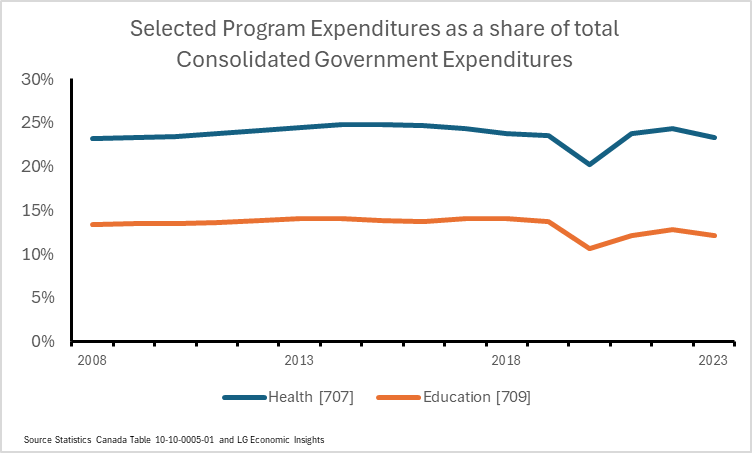
Government expenditure on health includes medical products, outpatient services, hospital services, public health services, R&D health and Health not elsewhere classified. Improved health outcomes support increased factor productivity by increasing the number of healthy (mental and physical) productive hours worked per labour input, lower sick leave, extended length in the labour force, experience retention, etc.
Government expenditure on education includes pre-primary, primary and secondary education, college and university, R&D education and education not elsewhere classifies. Education outcomes supporting higher total factor productivity includes ever higher levels of literacy, numeracy, critical thinking and critical analysis.
Comment:
Despite the shocks to the socio-economy over the last couple of decades Canadian governments have maintained the relative priority for health and education programs as revealed by their expenditure profiles. However in an earlier post it was noted that Canada’s total factor productivity has leveled off since the early 20-teens. This suggests that the existing level of investment is insufficient to maintain the pace of socio-economic growth that Canadians have grown accustomed to over the last generation. This rather simple observation suggests that it would be advisable for Canadian governments to invest in productivity-enhancing programs. The headline alternative government strategy is to cut taxes.
 LG Economic Insights
Leave a comment