
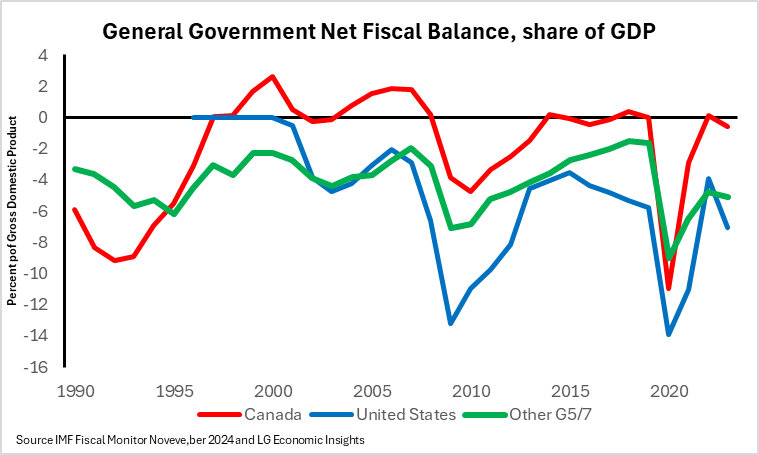
Canada’s broadly defined government sector been fiscally conservative compared its peer countries since the beginning of the new millennium.
Government services are delivered by national, subnational (provincial, territorial and aboriginal governments), and Nonprofit Institutions. Each country makes its own choice of the mix of mechanism to deliver government services. Government services include classic public goods – health, education, and security. Canada has an additional wrinkle with the evolution of constitutionally sanctioned aboriginal governments. The peer countries include the USA and the rest of the G7 countries: the United Kingdom, Germany, France, Japan and Italy.
Government budgets are the expense side of double-entry book keeping. Most of the benefits associated with government program spending are either difficult to measure (e.g. the benefits of an educated and healthy labour force by spending money today and getting the benefits over the worker’s lifetime) or simply not included in the balance sheet. Private sector accounting is much simpler, record the revenues as the offset to costs. Governments are a different institution to deliver non-marketed goods and services. There is a deeper issue here but it is beyond the scope of this post.
After the mid-1990s Canada’s aggregate government sector ran a relatively high fiscal balance. The balance for all peer governments was challenged by the Global Financial Crisis of 2007 to 2009 then the covid-19 pandemic. Primary beneficiaries of the coordinated government response to the Global Financial Crisis was the global financial industry. The financial industry is the intermediatory between the demand side of the market (borrowers) and the supply side of the market (lenders). The primary beneficiary of the covid 19 response seems more transparent although there is discussion that the response may have been harsher than optimal. In both case governments reacted to what were serious challenges. The fiscal response of Canada and peer counties is illustrated in Figure 1.
Narrowing to the analysis to Canada’s central government, the fiscal response to the tow major shocks to the economy since the turn of the century was strong in terms of Canadian domestic fiscsal management. The 2008 the Global Financial Crisis was the closest the economy came to the economic disruption of the Great Recession and the covid-19 pandemic was the most deadly influenza pandemic since 1918. The fiscal response was robust. The net fiscal balance approached minus 3 per cent of gross domestic product during the Global Financial Crisis. The severity of the pandemic is witnessed by rapid escalation of special emergency fiscal programs almost 12 percent of gross domestic product, an escalation seldom seen outside of a war effort. See Figure 2
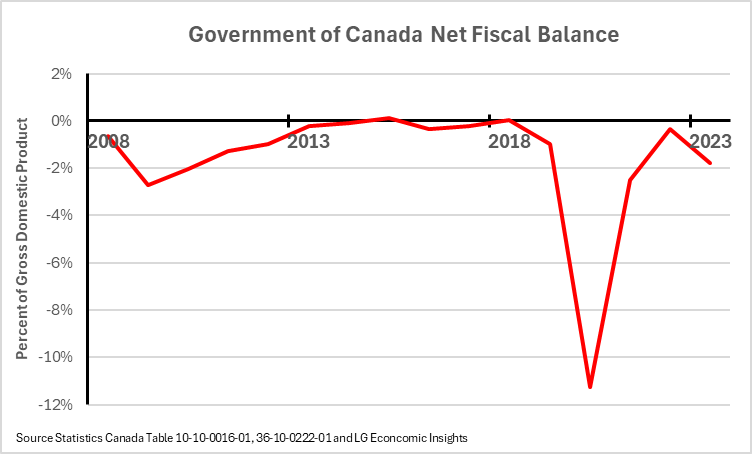
During both events Canada’s subnational governments contributed to the response, but, reflecting their lessor fiscal capacity, by less than 3 per cent of Gross Domestic Product for each shock.
 LG Economic Insights
Leave a comment