
NPISH is the smallest of the six economic sectors of the Canadian economy. It is an indicator of the vitality of civil society. accounting for approximately three per cent of the quantity of labour employment at less than eighty percent of the average wage.
Non-profit institutions serving households provide goods and services at low prices to households. They are may be created by associations of persons to provide goods or, more often, services primarily for the benefit of the members themselves. The services are usually financed by regular membership subscriptions or dues. They include professional or learned societies, political parties, trades unions, consumers’ associations, churches or religious societies, and social, cultural, recreational or sports clubs. They do not include bodies serving similar functions that are controlled by government units. Religious institutions are included even when mainly financed government if this majority financing is not seen as empowering control by government.
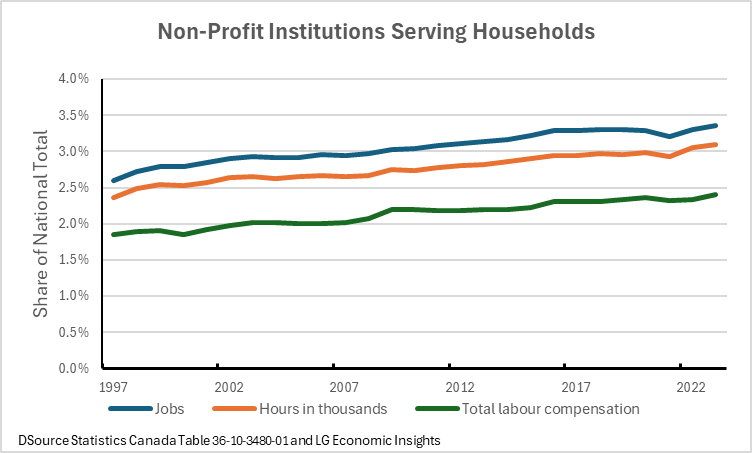
The non-profit sector attracts volunteers and a disproportionate share of older workers. As illustrated in Figure 1 the non-profit sector increased at a modest rate until 2017, stabilized then fell in the lead up to the pandemic shutdown. By 2023 the sector had rebounded to its pre pandemic level of employment.
In an earlier post the World Bank combined the NPISH with the consumer sector to track trends of consumer consumption. Assuming that the Canadian economy is typical of most 21st century economies the statistics for the NPISH sector would not affect total consumer trends.
This has been a short technical posting to take note of certain issues that were not addressed in the earlier post of the consumer in the economy.
 LG Economic Insights
Leave a comment