
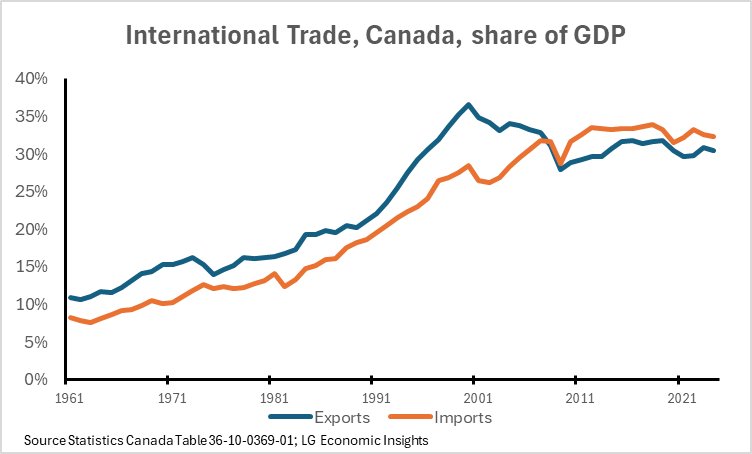
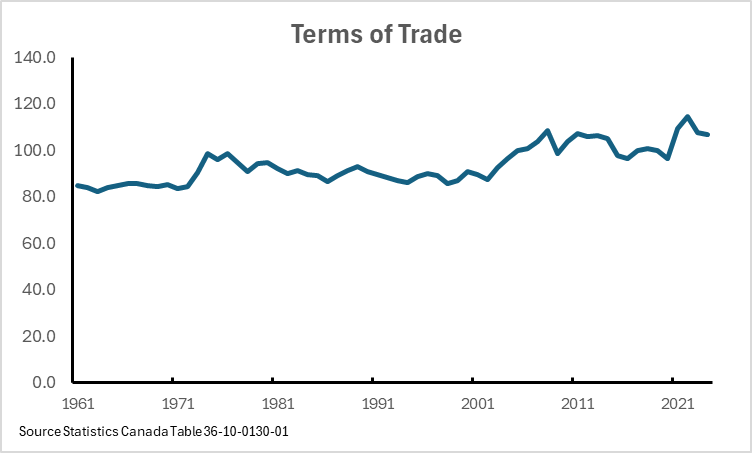
The Canadian economy is based on international trade. Almost one-third of the economy sells into the international marketplace. Since 1961 the terms of trade have turned in Canada’s favour: the relative value of Canada’s exports has risen relative to what Canadians import.
Canadian exports started from ten percent of GDP in 1961 rising to over one-third by the year 2000. There was one brief interruption during the 1973 Oil Crisis, which birthed “stagflation” a period of low economic growth with inflation. Exports were a larger share of the economy than imports until the 2007 Global Financial Crisis. As shown in Figure 1 imports continue to be a larger share than exports.
Over the period since 1961 the price of Canadian exports has risen at a faster rate than the price of Canadian imports, meaning that exports could purchase more imports. The ratio of the price of exports to the price of imports is the Terms of Trade. At one time the Canadian economy was stereotyped as hewers of wood and drawers of water. Symbolized by the opening of the St. Lawrence Seaway (1959) then the Canada-United States Automotive Products Agreement (1965) the Canadian economic productivity leapt upwards and improved the terms of trade. Of course the story is much more sophisticated but that is beyond the scope of this post.
Canadian exports are capital intensive, requiring investments in social and public infrastructure (education, health and transportation & communication) that have long investment horizons, risk and uncertainty. Part of this risk is shared between the private and the public sectors, it is also shared with beneficiaries in the global socio-economy through rules sanctioned by international treaty.
 LG Economic Insights
Leave a comment