
Canada’s agricultural sector has weathered more than its fair share of storms—both literal and figurative. From world wars to pandemics, from droughts to technological revolutions, agriculture has remained a cornerstone of the Canadian economy. Each wave of disruption brought new challenges, yet the sector adapted with tenacity and innovation.
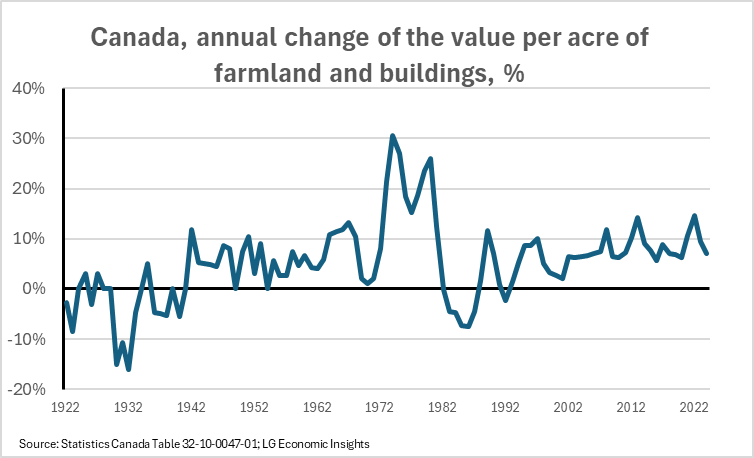
Mechanization, bio-genetic breakthroughs, and expanding infrastructure have reshaped farming practices. Despite periodic economic setbacks, such as the Great Depression and the 1980s downturn, farmland value has trended upward, reflecting the sector’s long-term profitability. Farmland, as a capital asset, encapsulates the expected net income of future operations—proof that agriculture continues to be a viable economic engine.
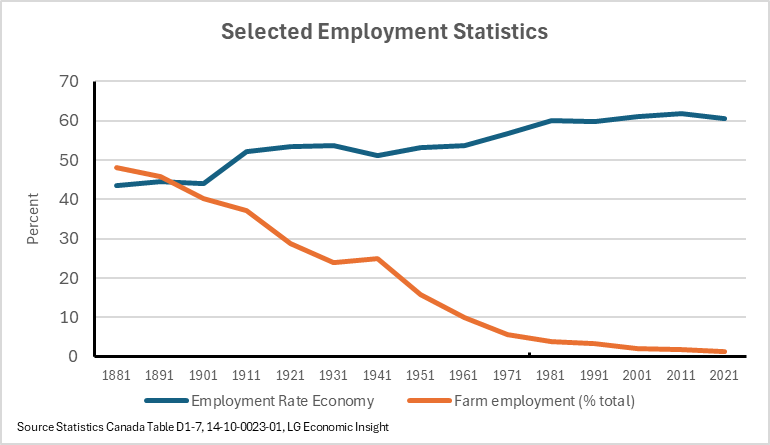
Mechanization reduced farm labour needs dramatically, yet the broader economy experienced rising employment rates. This shift demonstrates how technological progress in agriculture freed human capital to fuel growth in other industries. What was once a majority rural workforce has gradually evolved into a diversified, urban-driven labour market.
Now, the Canadian economy and the global socio-economy stands at a new crossroads. Artificial Intelligence (AI), along with robotics, climate change, and bio-engineering, forms the suite of mega-trends shaping the future of work.
Canada’s mining industry is there now. Reuters reports (July 16 2025, internet edition): Suncor has deployed the world’s largest autonomous ultra-class haul truck fleet at a single sight. These trucks use GPS, LTE communication, and advanced sensors to transport bitumen 24/7 without human drivers. By the end of 2025 Suncor plans to haave 140 autonomous haul trucks in services.
A centralized control room oversees operations, improving safety, efficiency, and reducing maintenance costs.
And Imperial Oil’s four-legged robots— each nicknamed Spot because of their dog-like appearance — prowl the vast 45-year-old Cold Lake operation in Alberta, conducting routine equipment inspections and maintenance such as heat exchanger optimizations, and oil/water tank interface monitoring. The Spots free up human workers for other work and save Imperial CDN$30 million ($22 million) a year.
The real question is: Will AI be a partner in progress—or a threat to livelihoods?
- If AI is harnessed to augment productivity, workers and businesses alike could benefit.
- If AI is deployed solely to replace labour and minimize costs, the social fallout could resemble a modern-day Luddite scenario.
- If the global socio-economy is to continue its advance towards progress and advancement, the win-win solution is ensure that workers and employers adopt the longer-term “augment” strategy, not the short-term “minimize costs” option. Social and public policy will be determinative to effect the strategy.
History shows that progress is possible—but only with intentional strategies. Public policy, education, and employer buy-in will determine whether AI becomes a tool for empowerment or dislocation. The choice is ours. Let’s make it wisely.
 LG Economic Insights
Leave a comment