
Socio-political concerns about inflation have now focused on the high cost of housing. The Bank of Canada publishes a cost of housing index, a measure that includes principle, interest, taxes and utilities. However the greatest challenge may be the transfer of seniority in decision-making from an older established generation to the next generation.
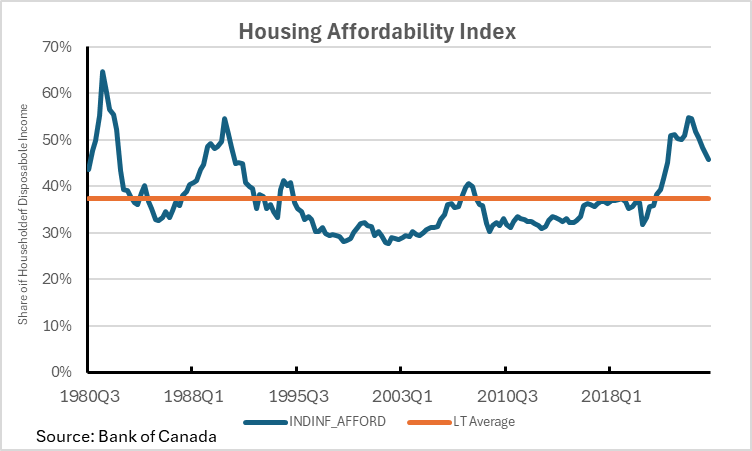
The Bank of Canada’s index is a ratio of housing-related costs (mortgage payments and utility fees) to average household disposable income. The higher the ratio, the more difficult it is to afford a home. The long-term average ratio is 37.7 percent. In mid-2023 the index approached its previous high in mid-1990. The index has now turned downward but still remains at levels well above its normal levels over the last couple of decades. See Figure 1. There has been a noticeable uptick since 2020, peaking on 2023 then reversing direction.
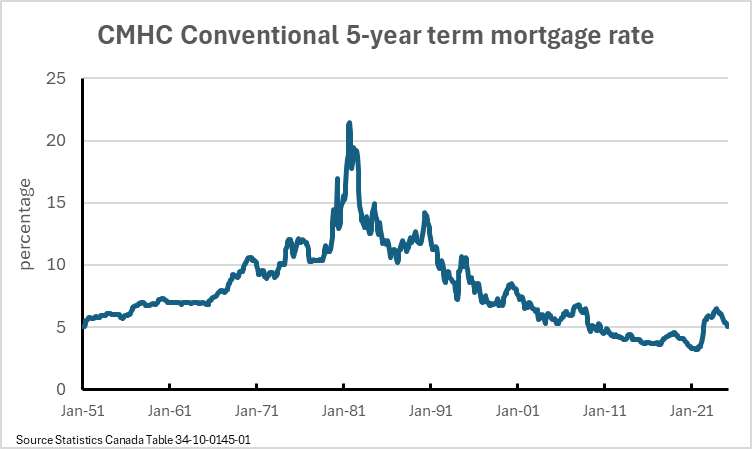
The cost of money, mortgage rates are not unusually high and is not contributing to the deteriorating housing affordability. The long term average mortgage rates is 8.0 per cent. Figure 2.
The issue focuses on the younger generation just breaking into the market. The story is simple. A new graduate has problems finding their first job, thereby delaying marriage, founding a family and establishing a new home. A casual look at the employment rate by age suggested that the age group entering their retirement years are delaying their retirement, plugging the employment channel for the younger generation.
Through to 1990 the employment rate of the 45 to 65 year old cohort was 60 per cent. The employment rate rose to almost 75 per cent by 2024, just over a million jobs that may have been available to the next generation. One factor was increasing economic uncertainty facing workers weighing retirement to rely on pension income. The 9 11 terrorist attacks with the complete shutdown of the economy, followed by the global financial crisis of 2007-08 and thr anemic recovery over the next decade all contributed to the hesitancy of accepting retirement. Then the global pandemic capped it all off.

Conclusion
The housing affordability crisis is not just about rising prices, the transfer of seniority and decision-making responsibility from an older generation to the up and coming generation may be its most serious challenge. The issue is to identify a win-win strategy, not always a natural path to our society to seek.

 LG Economic Insights
Leave a comment