
This post identifies and evaluates key performance metrics for assessing how Canada’s evolving trade policy is shaping the economy of Sault Ste. Marie. The selection of indicators is not exhaustive, but it relies on readily available public data and provides a foundation for monitoring resilience and vulnerability in the years ahead.
Context: A City on the Front Line of Trade Policy
Sault Ste. Marie is a northern, resource-export-dependent community whose economy has long been tied to U.S. demand for steel, forestry products, and tourism. This dependence makes the city especially sensitive to shifts in American trade policy. Historically, cross-border trade has oscillated between periods of liberalization and protectionism, with tariffs and quotas producing immediate local impacts.
On January 20, 2025, President Donald Trump began his second term by declaring a sharp turn toward protectionism. The message was clear: the United States would prioritize domestic producers, even at the expense of longstanding allies like Canada. Given its economic profile, Sault Ste. Marie was among the Canadian communities most exposed to this policy shift.
Canada’s Response
The Government of Canada has adopted a strategy designed to mitigate the risks of American protectionism and diversify opportunities for Canadian exporters. The core elements include:
- Market Diversification – Leveraging trade agreements such as CETA (EU) and CPTPP (Asia-Pacific) to reduce reliance on U.S. markets.
- Value-Added Production – Investing $700 million in electric arc furnace technology at Algoma Steel, positioning the company to compete in markets sensitive to carbon pricing, such as the EU under the Carbon Border Adjustment Mechanism (CBAM).
- Domestic Support Measures – Providing financial assistance and transition support for workers and industries impacted by trade shocks. For instance, Ottawa’s $2 billion steel and aluminum package in 2018 stabilized production and safeguarded jobs during tariff disputes.
This national strategy sets the stage for evaluating Sault Ste. Marie’s local performance across multiple socio-economic dimensions.
Local Performance Indicators
Population Trends
After decades of stagnation and decline, Sault Ste. Marie’s population has rebounded, rising from 80,001 in 2018 to 88,012 in 2024. Much of this growth reflects immigration and regional resettlement programs designed to revitalize northern communities. Continued growth will depend on employment opportunities and the city’s ability to retain youth.
Labour Force Characteristics
The unemployment rate has fallen from over 10% in the early 2010s to 5.6% in 2024, narrowing the gap with the national average. Gains are concentrated in steelmaking, services, and public-sector employment. However, youth outmigration and skills shortages remain ongoing structural challenges.
Tourism and Cross-Border Flows
The International Bridge remains the primary conduit for American tourist inflows. Traffic collapsed during COVID-19, dropping by more than 70% in 2020, and has since recovered only partially. Border frictions, the stronger U.S. dollar, and changing travel patterns continue to limit full recovery, keeping tourism below pre-2019 levels.
Algoma Steel: Industrial Bellwether
Algoma Steel continues to serve as the cornerstone of the city’s economy. Following a successful restructuring in 2022, the company is pursuing major investments in low-carbon steelmaking, positioning itself for long-term competitiveness in global markets. Nonetheless, Algoma remains heavily dependent on U.S. buyers, leaving it vulnerable to tariff escalation or Buy America provisions.
Housing Market
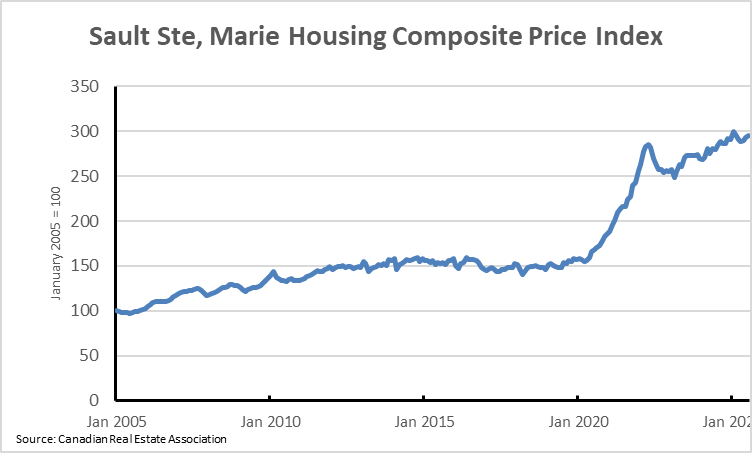
Average home prices in Sault Ste. Marie have risen sharply, from $190,000 in 2016 to over $300,000 by 2024. This increase reflects population growth, new investment, and renewed economic confidence. While affordability remains better than in southern Ontario, upward pressure on prices poses challenges for younger households and in-migrants.
Summary Table of Key Indicators
| Indicator | 2016 | 2024 | Notes |
| Population | 80,662 | 88,012 | Growth driven by immigration and resettlement |
| Unemployment Rate | >10% | 5.6% | Decline reflects steel and service recovery |
| International Bridge Crossings | Baseline (2019) | <90% of 2019 | Recovery ongoing but incomplete |
| Algoma Steel Status | Restructuring | Green steel investments | Still reliant on U.S. market |
| Average House Price | $190,000 | $300,000+ | Strong demand, rising affordability concerns |
Conclusion: Resilience Amid Vulnerability
Sault Ste. Marie remains on the front lines of Canada’s trade tensions with the United States. Yet recent trends point to cautious optimism. Population growth, falling unemployment, Algoma’s industrial transition, and a rising housing market all suggest that diversification and industrial upgrading strategies are bearing fruit.
Still, the city’s deep reliance on the U.S. market ensures continued vulnerability to American trade actions. Future success will depend on: – Expanding non-U.S. export markets for Algoma and other local industries; – Retaining and attracting a skilled workforce; – Strengthening tourism recovery through cross-border collaboration; – Balancing growth with affordability in housing.
In short, while Sault Ste. Marie has long been the “canary in the coal mine” for Canada-U.S. trade tensions, its recent trajectory suggests it is also becoming the “engine that could” for economic renewal in northern Ontario.
 LG Economic Insights
Leave a comment