
Canada was built on ambition. The Canadian Pacific Railway—our first great mega-project—stitched the country together from coast to coast, laying the foundation for both nationhood and economic growth.
Since then, Canada has relied on mega-projects—large-scale initiatives that reshape industries, communities, and entire regions. These projects are more than just big builds; they are bold investments, usually backed by the public sector, designed to transform the socio-economic landscape for generations.
What Makes a Project “Mega”?
- Public Sector Leadership – Strong backing from federal, provincial/territorial, and increasingly municipal governments.
- Infrastructure Focus – Concentrated on transportation and energy, the backbone of Canada’s growth.
- Lasting Legacy – A true mega-project endures. It sets the planning horizon for both public and private investment. A short-lived build, no matter how large, is simply a project—not a mega-project.
- Nation-Shaping Impact – Since WWII, about 20 such undertakings have defined Canada’s modern economy.
The Rise, Fall, and Return of Mega-Projects
- The Golden Era (1970s–1980s): Investment peaked as Canada embraced post-war confidence, tackling projects that mirrored the scale of the space race and The Cold War. Governments led the charge in financing and execution.
- The Decline (1990s–2000s): Public investment faltered. Inflation, shifting values, and a turn toward shareholder-driven priorities left fewer resources for nation-building projects.
- The Resurgence (Post-2008): Global financial crises reignited the case for public infrastructure. Governments once again stepped in, sparking a revival in mega-project spending.
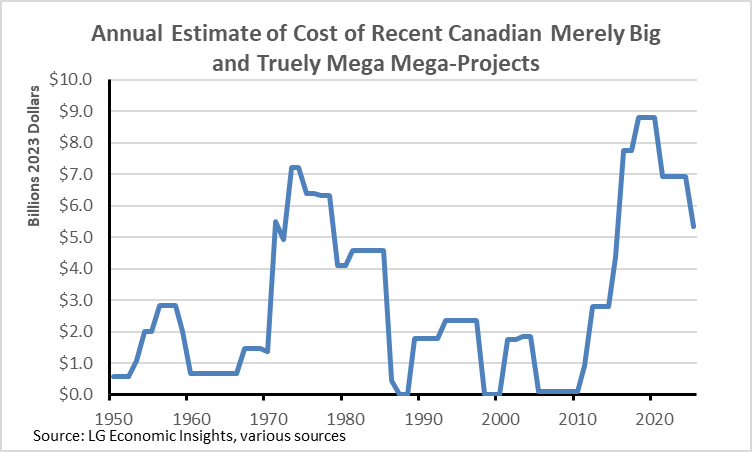
Investment Patterns (2023 Dollars)
- 1950s–1960s: Modest, under $1B annually.
- 1970s–1980s: Surged above $7B per year at the peak of expansion.
- 1990s–2000s: A lull, with some years showing little or no investment.
- 2010s–2020s: Renewed strength, with recent years topping $8B annually.
Mega-projects deliver far more than bridges, pipelines, or dams.
Why They Matter
- They expand capacity—more power, more throughput, more connectivity.
- They anchor industries, creating stable employment and the communities, schools, and health facilities that follow.
- They generate ripple effects across supply chains, fostering innovation and new industries.
Bottom line: Properly planned mega-projects are nation-builders. They create lasting economic resilience and spark the kind of innovation that ensures growth for decades.

 LG Economic Insights
Leave a comment