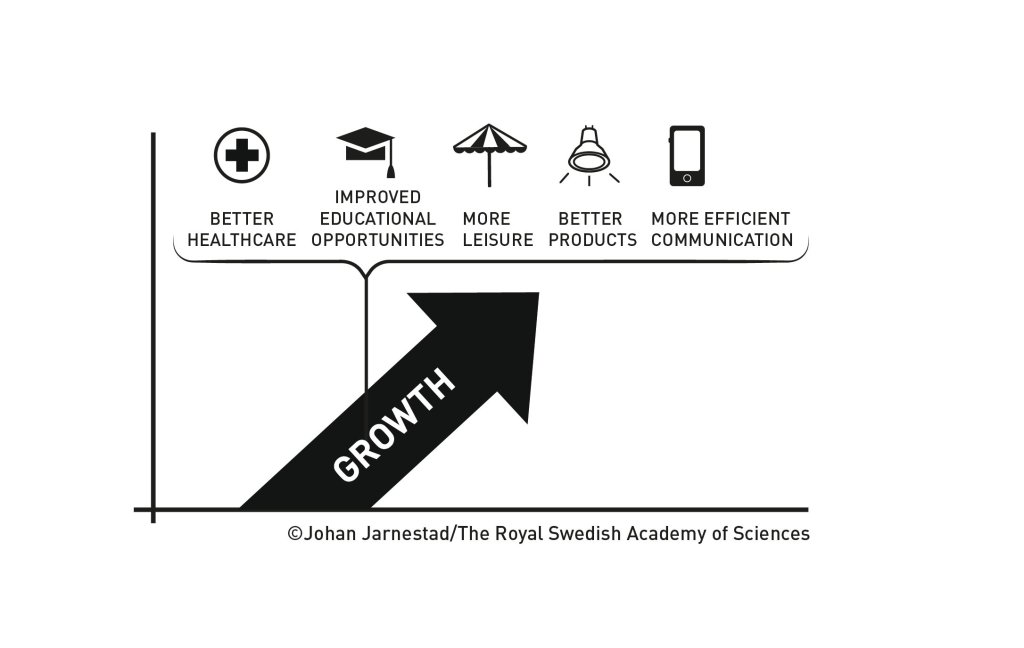
Creative Destruction is a process that fuels a dynamic economy, sustaining an innovation ethos incenting the global socio-economy to reach previously unimaginable levels of health, wealth, and well-being. This post focuses on the policy supports for sustaining the creative process. Peter Howitt and Philippe Aghion were awarded the 2025 Nobel Prize in economic sciences for their studies of the mechanisms explaining sustained growth.
This post is based on Philippe Aghion and Peter Howitt’s presentation, “Creative Destruction and U.S. Economic Growth,” at the 20th Anniversary Conference of the Center on Capitalism and Society. https://www.youtube.com/watch?v=U4coAolxPaE The post is structured reflecting the PowerPoint presentation slides; as such, it is suggested that this post be read while viewing the link above.
A couple of introductory comments:
The authors note that vigorous market competition supports the sustainability of the process, creative destruction is merely economic value destruction without the creative forces of fair market competition. It is noted that there are many well established strategies for “unfair” competition generally with the objective of protecting the “winner” from further competition including (1) regulatory capture, (2) using the economic rents to buy out potential startup competitors and (3) the old standby – corruption. These practices fossilize the economy, freezing creative competition.
The presentation concludes by noting that industrial policy may provide support for sustaining innovation and economic progress. One cited example is the “spectacular” success of the US Department of Agriculture‘s experimental stations from the 1930s through the 1980s promoting scientific farming. The success of the US Department of Defense and its support for research in computer technology, including the first (modern) computer and the first operating system, through to what is now the Internet. This discussion parallels Mariana Mazzucato’s research of the relationship between innovation, public policy, economic growth and the public-private sector partnerships.
Creative destruction was described by Joseph Schumpeter in 1942 in Capitalism, Socialism and Democracy.
A measure of innovation is Total Factor Productivity, the share of increased productivity above the simple increase of labour and capital. In Canada, Statistics Canada measures and publishes multifactor productivity. Canadian multifactor productivity follows a similar pattern as US Total Factor Productivity.
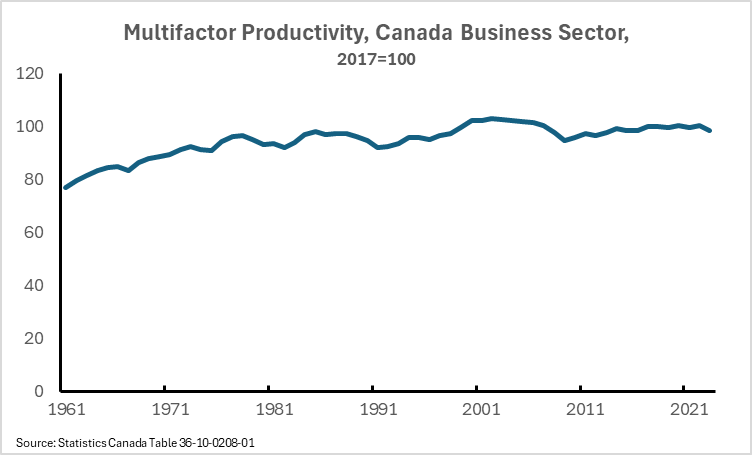
Possible explanations for the rise and fall:
- All great discoveries have been made
- Quality improvements hard to measure
- Superstar firms suppress creative destruction
Growth through creative destruction:
- Technical progress creates winners and losers
- Heterogeneous interests affect the process
- Potential for self destruction of growth;
- Automatic mechanism
- Strategic mechanism
Superstar firms suppress
- Increased concentration
- Increased markups
- Decreased labour share
- Increased profit share
- Highly correlated across sectors
- Composition effects
Superstar firms and the loss of Dynamism
- Increased leader/laggard gaps
- Reduced firm entry rates
- Reduced share of young firms
- Reduced job reallocation rates
- Reduced dispersion of firm growth
Why superstars?
- Winner-take-all technologies
- Relaxed anti-trust enforcement
- Increased difficulty of catch-up
- Decreased cost of acquisition
- Low interest rates
Possible remedies
- More vigorous anti-trust
- Focus anti-trust more on innovation
- Break up superstar firms
- Disallow anti-competitive patents
 LG Economic Insights
Leave a comment