On this penultimate day of 2025, the United States imposes import taxes on American purchases of goods from several specified economic sectors: steel, aluminum, energy, copper, potash, automobiles, and lumber. The stated objective of these measures is familiar: domestic producers are expected to increase production, employment is presumed to rise, and the balance-of-payments deficit is supposed to narrow. History suggests otherwise. This year the policy was attempted against imports of coffee and since the mid 1980s is has been imposed on softwood lumber imports. It has failed.
In 2025 import taxes were imposed on coffee beans. The United States does not produce coffee in any significant commercial quantity, yet it imports large volumes of green coffee beans. These beans are roasted, packaged, branded, and marketed domestically—think Seattle—and then sold both at home and abroad. An import tax on coffee beans does nothing to encourage domestic bean production; instead, it compresses the profit margins of U.S.-based roasters and marketers. Firms respond by cutting costs, delaying investment, or reducing employment.
While such a tariff may marginally reduce the coffee-bean component of the U.S. trade deficit by lowering import volumes, it simultaneously undermines exports of higher-value processed coffee. Foreign buyers can simply roast the beans themselves, bypassing U.S. processors entirely. In this way, an import tax on a natural resource can weaken precisely the domestic industries that generate the most value, employment, and export potential. The balance-of-payments arithmetic may shift on paper, but the underlying economic position deteriorates.
Import taxes on Canadian softwood lumber provide a real-life instructive case. These measures have been in place, with periodic renewals, for nearly two generations—dating back to the mid-1980s. Rather than stimulating domestic supply, the primary effect has been to create an industry dependent on protection. Domestic producers have become accustomed to the price support provided by tariffs and now regularly lobby for their continuation. Despite decades of protection, there has been no meaningful increase in U.S. production of softwood sawlogs. See Figure 1. Meanwhile, lumber prices have risen persistently, contributing materially to higher housing costs. Housing affordability has now become a major social and political issue, with protectionist lumber policy playing a nontrivial role.
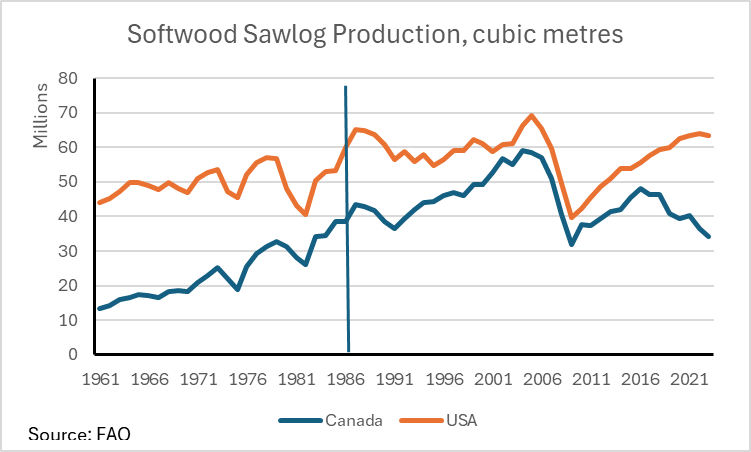
Protectionist surcharges on Canadian softwood lumber were first imposed in 1986 and, following a series of administrative reviews, remain in effect today. The anticipated surge of “animal spirits” among U.S. producers never materialized. Instead of expanding capacity to replace Canadian supply, domestic firms have been content to collect unearned economic rents generated by artificially constrained competition. Softwood lumber is produced from softwood sawlogs, yet domestic sawlog output has shown no meaningful increase over nearly fifty years of protection, as illustrated in Figure 1.
The result has been a structurally constrained supply facing steadily rising demand. Predictably, prices have risen. Elevated housing costs are now a defining economic and political challenge in the United States. These outcomes reflect deep distortions in price signals for one of the most fundamental household expenditures—shelter. By inflating the cost of housing, protectionist lumber policy has eroded the real incomes of American consumers for decades. After half a century of evidence, there is little reason to believe this trajectory will reverse under the same policy regime.
In short, American protectionism in lumber—and increasingly in other input-intensive sectors—has failed to deliver its stated objectives. Instead of strengthening domestic production and employment, it has entrenched inefficiency, raised consumer prices, and weakened value-added industries. The costs are widespread, persistent, and borne primarily by American households.

 LG Economic Insights
Leave a comment