The unemployment rate is a popular measure of well-being of the economy. It is a measure of the number of people seeking employment but unable to find a job. It is a more tangible measure of the health of the economy than, say the Gross Domestic Product, an accounting construct.
Some background. Statistics Canada conducts the monthly Labour Force Survey of Canadians of almost 50,000 Canadians. It measures the potential labour force, all people aged 15 years and older. The active labour force includes people actually employed and those actively but unsuccessfully searching for a job. The participation rate is the share of people in the active labour force as a share of the potential labour force. There are many reasons why people 15 years and older may not be looking for a job – a topic for another note.
The unemployment rate is the share of the active labour force that is unemployed, it is influenced by changes in the participation rate and the number of unemployed. Statistics Canada surveys all ten provinces and three territories to report the labour force statistics.
The unemployment rate for Canada, Saskatchewan and Newfoundland & Labrador since 1996 illustrated below. This period had a number of economic shocks that disrupted the economy, starting with the dot-com melt down in the late 90s, the 9-11 terrorist attack, the global financial crisis and the covid pandemic. Given these global shocks unemployment rates were fairly stable.
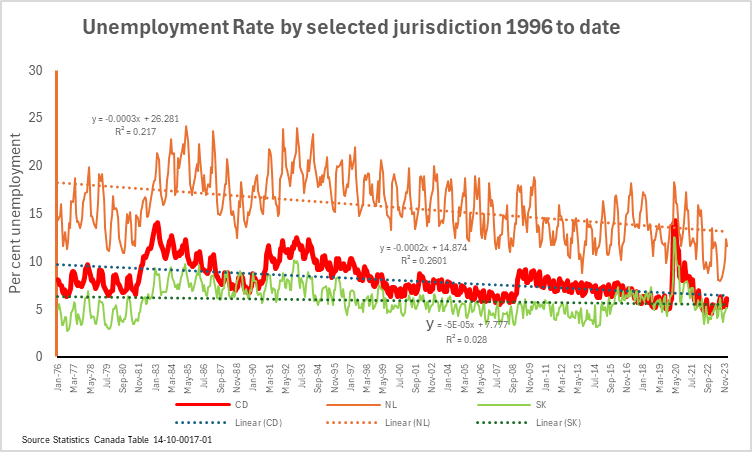
The 1996-date average unemployment rate for each of the 14 Canadian provinces and territories are :
Canada 8.1%
Newfoundland & Labrador 15.7%
Prince Edward Island 12.1%
Nova Scotia 10.1%
New Brunswick 10.9%
Province of Quebec 9.3%
Ontario 7.4%
Manitoba 6.3%
Saskatchewan 5.9%
Alberta 6.6%
British Columbia 8.1%
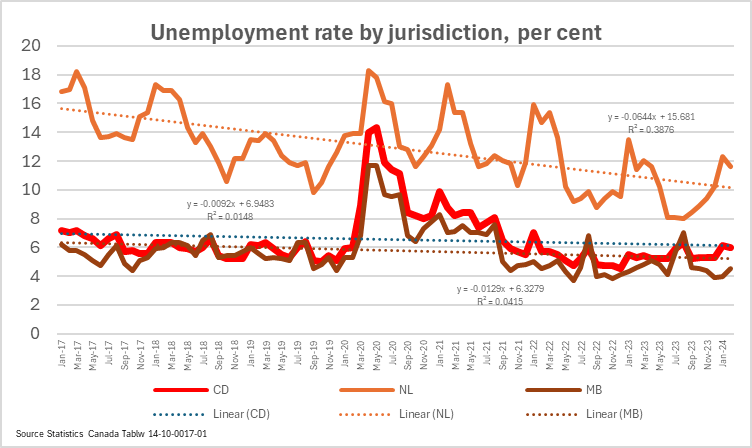
The next figure focuses on the most recent period, the lead and the economic recovery from the pandemic.
The associated spreadsheet is attached.
 LG Economic Insights
Leave a comment