
The world has reached and sustained a level of income and a quality of life unimaginable to anyone before the seventeenth century. The metamorphosis of a subsistence life-style to the luxury-rich, information-based modern digital economy is jaw-dropping.
Early shoots of the transformation appeared in the UK, taking firm root with the repeal of the Corn Laws in 1846 and the country’s unilateral implementation of universal free trade. Political economics provided the intellectual support to shift trade policy away from protecting the land-based aristocracy with high domestic agricultural product prices towards a cheaper food policy supporting the growth of the urban based industrial economy.
The success of the UK socio-economy led many to adapt to UK’s recipe for their unique socio-economic context, spreading across the world over the next century. One summary statistic of success is income per person as displayed in Figure 1. Income per person is measured as gross domestic product per capita using a constructed monetary value to ensure a common unit of measure.
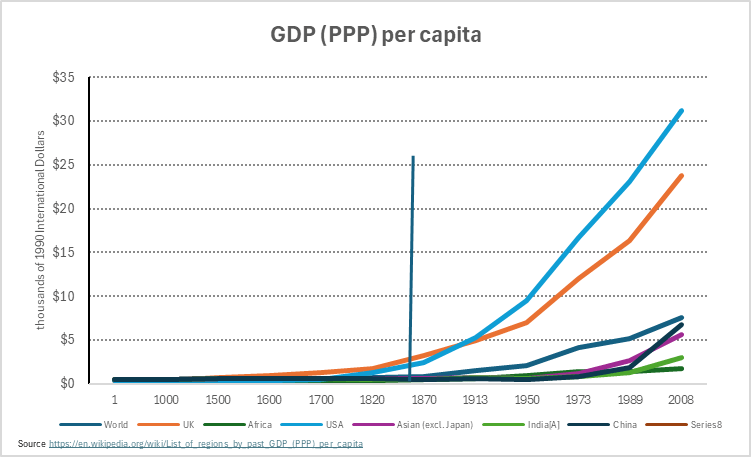
The economic metamorphosis began in the UK and the USA. By the beginning of the First World War the USA had caught up to the UK with income per capita with incomes increasing by 3 or 4 times its 1820 levels – an unheard of increase. With some caution and delay the recipe spread outward to most of the world . By 2008 European countries, both western and eastern had had increased per capita income by multiples of 13 and 18 over 1820 respectively. Multiples for Africa and China were 4 and 11 with China growing at blistering speed since 2008. The multiple from 1820 to 2008 for the world as a whole is 18! And that includes two world wars and the Great Depression.
A second measure of the success of new socio-economy is the remarkable increase in expected live time across the world.

Life expectancy is a function of infrastructure (water and sewerage for example), access to health services, wealth and healthy nutrition amongst other factors, all of which must be funded. Global life expectancy increased from just under 30 years old in 1770 to over 70 years in 2020. Moreover life expectancy for each of the regions was closely clustered in 1770 at the lower age. By 1900 global life expectancy had slowly increased to just over 30 years but regional difference became more evident. Global life expectancy increased to 50 years by 1955 but regional differences continued. By 2020 regional life expectancy converged just over 70. Although Africa continued to lag, it was closing the gap.
This post recognizes, acknowledges and celebrates the metamorphosis of the world’s subsistence socio-economy of the pre-seventeenth century to the modern digital economy of today. Today’s lifestyle including the distribution amongst countries is beyond the imagination almost all who lived before the modern age with the possible exception on Nostradamus.

 LG Economic Insights
Leave a reply to Electric Vehicles – Continue Global Economic Growth – LG Economic Insights Cancel reply