

Since the mid-nineteenth century, the global socio-economy has maintained a torrid pace of growth (as measured by real GDP per capita) and quality of life (as measured by average life expectancy). This is discussed in an earlier post, Rise of the Dismal Science. These benefits have been shared with the rest of the world through a number of transmission mechanisms. These mechanisms were discussed in an earlier post, The Smile Curve.
It is expected that this pace will be maintained, perhaps accelerated into the future with its centre of gravity shifting towards Africa.
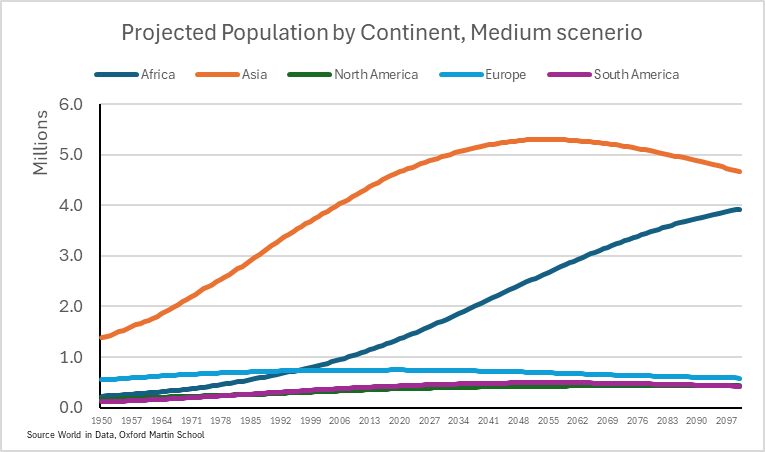
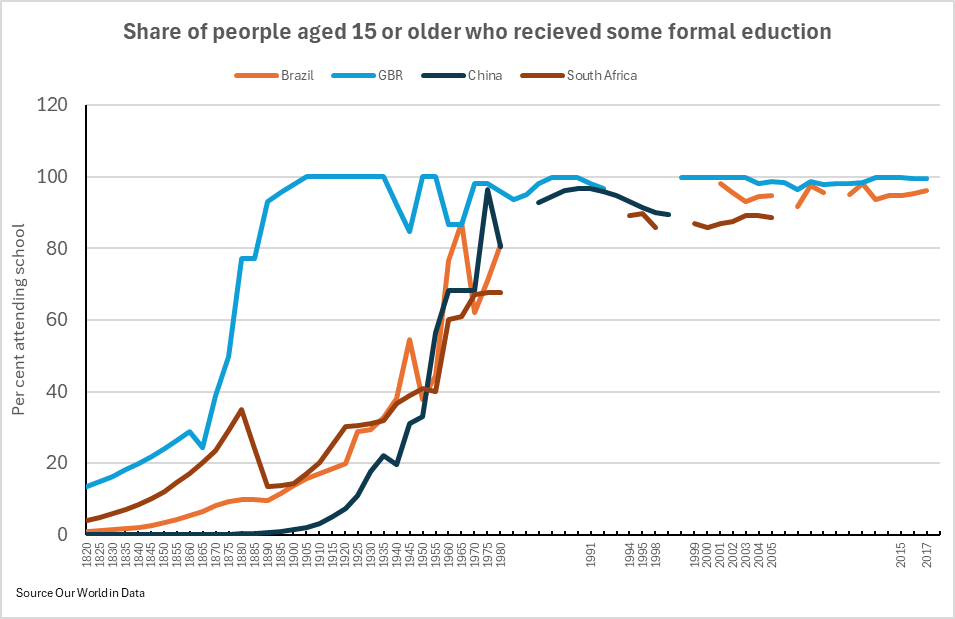
The global supply of labour is projected to increase through this century with explosive growth in Africa. See Figure 1. And there is a commitment to education where countries are converging. See Figure 2 which indicates that in the commitment to education, starting with people over the age of 15 with some sort of education, is showing positive uptake since mid-twentieth century. Commitment to higher education whether academic, vocational or artistic is expected to strengthen with demand and increased economic growth. As such the global supply of labour will increase in terms of its quantity but also, with appropriate training and education, quality.
Many potentially disruptive and market-making scientific technologies are presently being pursued. A list of ten of the leading possibilities is provided below. Developing these new technologies and products will require major inputs of skilled labour, new supporting infrastructure and new business models at the very least. The final product for sale in the marketplace may take one or two generations of consumers. Given the expected surplus of highly educated and skilled labour the transmission mechanism of future global property will shift towards the Smile Curve.
From ChatGPT/Co-Pilot
Future Disruptive Technologies
- Quantum Computing: Quantum computers could revolutionize computation by solving complex problems faster than classical computers. They’ll impact fields like cryptography, drug discovery, and optimization.
- Biotechnology and Genetic Engineering: Advances in gene editing (like CRISPR) will lead to personalized medicine, disease prevention, and enhanced crop yields.
- Artificial Intelligence (AI): AI will continue to evolve, impacting everything from autonomous vehicles to healthcare diagnostics. Ethical considerations and regulation will be crucial.
- Renewable Energy: Innovations in solar, wind, and fusion energy could transform our energy landscape, reducing reliance on fossil fuels.
- Space Exploration: Technologies for interplanetary travel, asteroid mining, and lunar bases will expand our presence beyond Earth.
- Nanotechnology: Manipulating materials at the atomic or molecular scale will lead to breakthroughs in medicine, energy storage, and manufacturing.
- Neurotechnology: Brain-computer interfaces, neuroprosthetics, and brain-inspired computing will enhance human capabilities.
- Climate Tech: Solutions for carbon capture, sustainable agriculture, and climate adaptation will be critical.
- Materials Science: Lightweight, super-strong materials will impact transportation, construction, and electronics.
- Health Tech: Wearable devices, telemedicine, and personalized health monitoring will improve healthcare outcomes.

 LG Economic Insights
Leave a comment