
This post presents the latest data for greenhouse gas emission intensities in Canada. Statistics Canada reports annual greenhouse gas emissions as kilotonnes by sector. This post focuses on two sectors, (1) all industries and (2) households. Of course sectors are composed of various subsectors but reporting at the subsector level is beyond the scope of a simple post. Data is reported for each of Canada’s ten provinces and three territories, annually from 2009 to latest 2021. Detailed data is included in the attached spreadsheet for readers.
Findings are recorded as the change of emissions between the 3-year average at the beginning of the data period, 2009 to 2011 and the 3-year average 2019 to 2021. The following charts are for a subset of jurisdictions: Canada as a whole, Quebec as an original and founding provinces, and the Northwest Territories classically cold with aspirations of provincehood.
Industrial emissions will reflect the industrial composition of each province and territory. To enable a more meaningful comparison the intensity of emissions per dollar GDP is calculated. The economic composition of the economy is a long-term market-based legacy. There are policy instruments to encourage less emission-intensive paths but those are beyond this post. Emissions declined for all jurisdictions except Nunavut.

Similarly household emissions reflect the size of the population. Local climate but Canada is cold everywhere, colder in the north but cold in the south so it is ignored for this post. Household greenhouse gas emissions are expressed as tonnes per capita.
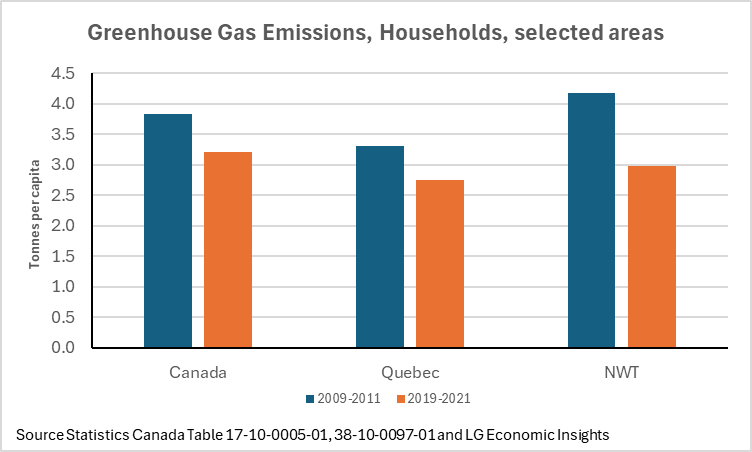
Household greenhouse gas emissions declined in all jurisdictions except Newfoundland & Labrador, Manitoba and Nunavut.
Details are in the attached spreadsheet.
Findings:
- Canada did reduce greenhouse gas emissions over the data period.
- It is not known whether this reduction met Canada’s share of the global burden.
- Reducing the household sector’s emissions may be more amenable to government incentive measures (standards, regulations and incentives) than the industrial sector that must compete in the global market place given its initial endowment.
Global governance context. Canada is a contributing member to the global ambition to reduce greenhouse gas emissions. The global target is derived in terms of limiting global temperature warming. Although science-based, science is always learning and improving its knowledge base and announcing model-based revisions undermines the veracity of the target. As such the latest target is not referenced for this post.
 LG Economic Insights
Leave a comment