
This post focuses on the relative performance of the Canadian economy over the course of the last generation, roughly since the 1979. This period has had a variety of economic shocks of global significance and that tested the resilience of the global economy. It started with the energy crisis in 1979, thorough various financial and banking collapses during the ’90s, 9-11, the global financial crisis in 2007 leading to the covid-19 economic quarantine. Comparing the performance of the Canadian economy against the American economy (the gold standard) and other advanced national economies provides insights of Canada’s economic resilience.
To compare national economies, they are measured in Purchasing Power Parity (to reflect national purchasing power given domestic markets) and in constant 2021 international dollars to address the currency issue. The World Bank and the IMF provide these data.
Figure 1 below plots the GDP per capita for selected countries against the USA. Canada is plotted as the red bars, Germany and France included as advanced economies. Finally the OECD includes most if the advanced economies in the world. There is some overlap as the OECD includes the four countries already in the figure.
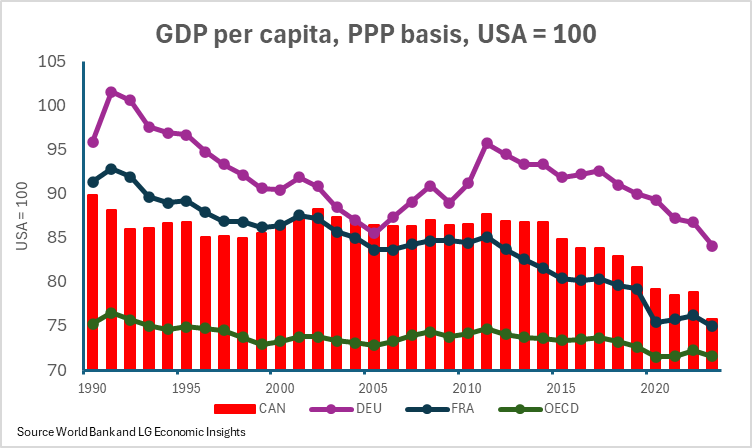
It is noteworthy that Canada stays level with the American economy until 2012 when all countries included here drop behind. It is more that the American economy took off leaving the rest of the world behind. That was the year that the US Fed aggressively pursued novel policy instruments such as quantitative easing to energize the American economy after its sluggish emergence from the 2007 global financial crisis and the 2012 presidential election. And the American economy has maintained that lead to this date.
Regarding the Canadian economy it is noted that ignoring PPP adjustments, in domestic currencies the Canadian and American economies have increased by 73 per cent between 1997 and 2023. the difference between the PPP measured increase and the nominal domestic currency measured increase will lie in the structure of the economies. That discussion is beyond the scope of this post.
Conclusions:
- Until 2012 the Canadian economy maintained its pace with the American economy through the various economic and political shocks. The Canadian economy demonstrated a degree of resilience compatible with the American economy.
- Canadian economic resilience, by this measure, was competitive with the Germany and France.
- As if this writing the American economy is out performing the rest raising the question why and what lessons are there for the rest of the world?

 LG Economic Insights
Leave a reply to Anonymous Cancel reply